


Sarah Stowe
So Brett, welcome. Tell us about the El Jannah brand, how it started, and exactly why is the brand so popular with its customer base?
Brett Houldin
Thanks, Sarah. Thanks for having me. It’s a phenomenal brand that’s been around for almost 27 years. It started in Western Sydney in Granville by Andre and Carol Estephan. And it was a family business that was never necessarily intended on being a national brand back then. And they went the first 11 years without opening a second restaurant. And they really created it off a love for the food that they had back in Lebanon when they first grew up there and came to Australia in the 90s. it was a dream of theirs to be able to provide that food to their community. And so Granville was the natural place to do so. And Carol would work on the menu and Andre would make sure the restaurant was run well, but the two of them would be in restaurant every single day. And it was really that love and passion for food quality and being able to provide something that meant a lot to them. If you look at how it’s evolved over the last sort of 27 odd years, the first 19 or 20 was when they really got from zero to five restaurants. But everything about the brand was built around quality food and amazing service. And they hadn’t spent a dollar on marketing until about two years ago.
So it wasn’t about driving more people in because they needed to meet hurdles and KPIs and metrics or anything like that. They just ran it with their friends and family in Western Sydney. And it became this cult-like following. And we sort of laugh now that everyone’s got a first El Jannah experience story. And when I’ve met people over the last five or so years, everyone wants to tell you when they first went to Granville or when the last time they went, what they ate and who served them and where their local one is. And it’s very refreshing to have a food concept that people seem to hold close to them and have memories of when they were at school or uni or when their parents or friends introduced them to them. So I think the essence was get the food right, focus on the guest and the service. And I think the rest of it’s taken care of itself.
Sarah
And just tell us exactly what is special about the food. What are we talking about when we say Lebanese heritage?
Brett
Well, El Jannah is in Arabic, it means paradise or heaven. And so that is as a phrase has really been the backbone of what they’ve brought to life. They wanted people to feel that when they ate some of their food. And Eljana, if you haven’t had it, would be something that you may have smelled charcoal chicken cooking somewhere in a neighbourhood somewhere and might have been an unbranded local family business and it was really based around a beautifully marinated splayed chicken over a live charcoal and then paired perfectly with garlic sauce, pickles, Lebanese bread, hummus, baba ganoush, things that maybe 20 or 30 years ago when the brand started were more foreign ingredients to an Australian palate but as that’s evolved and new Australians have come in and there’s been so many different varieties and flavors that have come to life. Those are the menu items that you can experience getting out of the supermarkets today. They’re less foreign and more about flavour. And the difference that El Jannah brings is freshness and quality and consistency that we’ve been able to hone, particularly through our cooking methods in restaurant, but also the fact that we own the bulk of our supply chain, which means that we bring produce and our ingredients into store six days a week, which comes through our central kitchens. And that means that, yes, you could get similar ingredients or products elsewhere, but you’ll never get it as fresh as what El Jannah can make, which I think is what sets us apart and why people keep craving it wanting to come back more often.
Sarah
So there are 47 stores I understand I think in the network now, predominantly in the Sydney home base along the New South Wales coast, in the ACT and also in Victoria. What’s driven the brand’s growth and development? You said that was very much that family focus, they were looking at the quality and the service. What’s changed? How has that kind of developed to reach the 47 store footprint that it is now.
Brett
Yeah, well, we’re moving at some pace at the moment. So we’ve reached 49. know, since you’ve written them, that’s right. Yeah, we will be at 50 in a couple of weeks time. It’s it’s a real fast pace rollout because we want more people to get more access to what we believe is is the greatest fresh, casual, highest quality ingredient food you can get. we’re really pushing hard.
Sarah
Since I wrote my notes.
Brett
just because we believe so strongly in it. I had the chance some years back when I was at Cravable, really just looking at what best practice was in the chicken category. And we did some research and me and the team sort of looked at all brands far and wide, domestically and some internationally. I wasn’t from the areas that El Jannah was serving in Sydney then, but having got to know the founders, the Estephans, and enjoying the food over sort of 2017 through to 2019. It really sort of came through. The product was just phenomenal. And so when an opportunity came in 2020 for me to get involved and partner with the founders to make this brand a national leading sort of fresh casual chicken operator, I was very, very keen. so, you know, it’s been very much around looking at what our brand really stands for. What are the great things that guests love and what they’re coming back for? Building a team to make sure we can expand that and roll that out at scale with consistency and high quality.
And then,you know, look at the catchments across Australia that we think we’re going to be the most successful to begin with and expanding. And we’ve been now in Melbourne for three years. We’re about to go into Queensland in the next 12 months, Adelaide as well. And so really, we’ve done a lot of research around our property pipelines, why we’ve been successful in the markets that we’ve done well, why we believe there’s a strong retail platform in new markets and when you look at chicken as a protein, it’s the most consumed, it’s the most cost effective, it’s what people seek. But we do it differently. We cook it over live charcoal. We accompany it with a fantastic arrangement of sauces, dips and salads. And we’re more focused on a shared meal occasion, which means we can be more things to more people, but without having the widest menu that is needed.
I think that’s given us the courage to go into these new markets and expand as quickly as we’ve been able to. We’ve said we want to get to 200 stores in the next couple of years. I believe we’re on track for that. And that’s really just about making sure that we can remain true to who we are, uphold the legacy of the Estefans and demonstrate that consistently with every corporate or franchise restaurant as we keep rolling them out.
Sarah
So you’ve designed the brand value creation plan. I’m just wondering for people that perhaps don’t know what a brand value creation plan is, can you talk us through that and what it is for El Jannah?
Brett
Yeah, it’s been a really great partnership between Andre and myself over the last five, five and a half years since we sort of joined together and really just setting the brand up for long-term sustainable growth, both for our existing franchisees, our team members that have come in, and particularly our shareholders. And so in designing a plan like this, which we did in early 2020 and we revisit it annually, but really just looking at where we can win, how we’re going to extract value to win, and make sure that that’s done in a very measured and ongoing manner, which ensures we don’t misstep as we keep growing. And so we’ve gone from three people in the office when I joined, me and Andre and his family, to now over 60 people in our head office in Sydney, over 120 people in our supplies production business and And we’re growing it sort of 20 % 30 % a year in terms of headcount. But the people we bring in and want to be part of this great journey, you know, they want to make a difference. They want to make sure that we are upholding the the brand standards that we’ve gotten and really the people that we have around us are going to be the enablers of that which is the the epicenter of our value creation plan and naturally then the food, the restaurants, our franchise partners, our supply partners to make sure that we can do it in a way that we’re here for the next 50 or 100 years. And we’ve got a brand that is a powerhouse in Australia and beyond. So it’s a blueprint for success. It allows us to hold ourselves accountable to what performance matters, prioritize and make sure that the team know what’s going to matter most as we grow. And when you’re growing at 30, 40, 50 percent a year in sales or restaurant growth, you need your bookends and your guardrails to make sure that you know what good looks like and you know what bad looks like and you can recalibrate as you go.
Sarah
Can you just give us a little bit more idea about the ideal locations because you said you’re looking for the right kind of communities to all the right places to be in. So just in terms of geography and the product offer, are the key things that you’re looking for to ensure that you’re expanding in the right place?
Brett
Yeah, we look at both our history as to what’s worked and we also look at the trends and growth cohorts across the country as well. Having started in Western Sydney and almost entirely in strip sites or shop fronts up until 2020 when first launching a drive-through, we honed that, made sure that we understood how that works best and ensure that the menu and the operation standards can ensure that we can not just compete but be the most successful in drive-through because we believe that with the renaissance post-COVID of what people are looking for and convenience that drive-through is really important to them. So we’re looking at continuing to grow our drive-through footprint as well where we hope to get to more than 50 % of our footprint in the next couple of years and not without discounting the need for strip site shop fronts in key metro or suburban areas where we might not be able to get a drive-through.
I think it’s really getting the balance right between size and available space and convenience versus being in areas that you know that are going to work. And so when we went to Melbourne a few years back, our first two locations were drive-throughs. And they were conversions at the time. We’re now looking at more greenfield drive-through site locations, which can take up to two or so years. And so you’ve got to have a strong pipeline brewing in the background, which we’ve been working on now for a number of years. But it’s not that one size fits all. Obviously, we go into a lot of shopfront locations where we can be equally high in terms of performance.
We’re also learning a bit around ethnicity, cultural differences, diversity of the way that we can serve different groups. So if you look at the brand, it performs well in say Western Sydney, but it equally has performed particularly well of late in the Eastern suburbs and the lower North Shore where we’ve gone into more affluent areas, it’s performing above brand averages. Same when we went to Melbourne, we’ve gone now into Melbourne CBD location in Swanson Street, and that is a very high performing restaurant. as you keep going into these new markets, you learn a bit more, it gives you more insights, you build more courage to want to grow and be in more areas. And we’re taking a similar approach now from all of those 50 restaurants to learn how best to approach South East Queensland as well as we enter that in next 12 months.
Sarah
And where does regional Australia sit with that, beyond kind of the, you know, the metro area? South-East Queensland is obviously a little bit different because that’s a big spread, the more regional towns, is that something that is in El Jannah’s targets?
Brett
Yeah, definitely. think if you look at Australia, we’ve got a lot of chicken operators that are servicing a lot of key markets, including Metro and regional. With KFC, it over 800, Craveable across a few brands, and now at over 600, a number of others that are in sort of one or 200. There’s a lot of opportunity for El Jannah to play in local communities, metro, regional parts. So in the last 12 months, we’ve gone into Ballarat, we’ve gone into Nowara, we’ve recently gone up to the Central Coast. We’ll be opening in Geelong and Pakenham has been around for a little while in Melbourne as well. As we keep building out, we’ll then be looking at some of the larger regional hubs, Wagga, Bathurst, Dubbo, Tamworth, Coffs, Port and Bendigo, they’re all on the map for us and we’ve got plenty of opportunities to go in them.
We’re just taking a very measured approach. We’re not at 100, we’re not at 200 restaurants yet. And we will build that regional strategy over time as we go harder into South East Queensland, South Australia, that will then give us more learning to then go into regional and then potentially Western Australia, Tasmania, New Zealand and so on. I really, really like the opportunity that we could present in regional locations. And we’ve seen some good performance out of those that operate today in those markets. It gives us a point of difference. And I think it would be in the not too distant future that we’re in more regional markets than what we are today.
Sarah
Now, the business has an impressive turnover. You’ve been quoted as saying this year’s figures will be between 250 million and 300 million. How have you achieved these results and how, and I’m wondering as part of that, important that supply chain that you control is to the numbers?
Brett
Yeah, when I got involved with the brand in 2020, I knew of the sort of cult-like following that drove its performance, where my expectation was it was of very high frequency of what guests were returning. And that meant that we could do a lot more with the business. We believe we have the highest turnover of any QSR brand at a store level. We keep growing that number and the brand itself has outstanding unit economics for franchisees and our corporate portfolio as a result. That is very much driven by our emphasis on a shared meal occasion where we’re more dominant than an individual meal occasion, which is why the Lebanese culture and that Middle Eastern flair of coming together over food and having it in abundance with generosity is really what I think people look for and are enjoying with the brand today.
We use the highest quality of ingredients, which 70 % of it comes through our production kitchens, where everything comes through from there, from farm to our facilities and to restaurants six days a week. Nothing’s frozen. Nothing’s further processed. It’s only the best quality. We own our parsley farms, so our tabbouleh is the freshest you can get and so on. And so that gives great economics for our restaurants. It also means we can control consistency across the network. We have two production facilities in Sydney, one in Melbourne, we’ll soon launch one in Brisbane. But it means that every restaurant gets the same. It’s a very high touch on our end.
It means that there’s a food safety element that we can manage, especially when it’s fresh, but it means that our guests get the freshest possible meals in market. And I think that’s why people can see the difference and can come back more often, which is why our restaurants perform as strongly as they do vis-a-vis the industry. So we’re very proud of that. We probably haven’t shared enough of that story yet around provenance, the freshness, the quality that we use and we’ll be continuing to sort of do that a bit more with our marketing as we grow.
Sarah
So picking up on that in terms of marketing and obviously customer experience, how important for the brand is digital engagement with customers and what are their expectations?
Brett
Yeah, it’s obviously how we consume media and engage with each other and brands today. If you look back at the heritage of the business, we effectively didn’t spend a dollar on marketing up until about two years ago. Really just used word of mouth and the product to do all the heavy lifting for us. We introduced a marketing fund in April last year, so under 18 months ago, that the network contributes towards and that has allowed us to bring in top talent as well as, so that’s internally as well as agency to support how we build on the brand story. We can drive transactions and volume and we can tell our existing and new guests all the reasons why El Jannah is better or different.
Digital plays almost singularly the greatest channel impact of marketing for us. We can measure it. We can also ensure that we’re agile because we can turn it on and turn it off. We can be dynamic. We can run different tests to see what’s more effective or what’s not. And it works on our own channels, but it also uses our broader media partners to allow us to do that. so that means that our marketing is able to achieve its highest return on investment. We can measure it. We can be more specific around geotargeting the right potential clientele. And we believe, even though it is still early days, that we’re able to get a very, very high return on marketing dollars invested. More recently, we launched an app in March of this year, coupled with the loyalty program.
And we’re generally doing about 10% of sales through members today. And we’re really pleased with how that engagement’s gone. It’s a very simple mechanic, which is easy to understand that our loyal members enjoy. And the app is really a facilitator for that. So we can talk to them, we can have a one-on-one relationship, we can drive their engagement over a life cycle and we believe wholeheartedly that this will be something that will be a differentiator for us in the future. having more owned channels, having more owned applications and loyalties is definitely going to keep growing for us.
Sarah
Now you bring experience, you’ve mentioned Craveable Brands, you’re were the CEO of Craveable, which is a parent company for Oporto amongst others, and you’ve recently appointed Craig Tozer, Craig Tozer has been appointed as Chief Operating Officer and he was a former Oporto boss. How does this combined experience shape El Jannah’s future?
Brett
Yeah, Craig and I have known each other a very long time, went to school together, worked together at Craveable. As you say, was CEO of Oporto and also a board member with me in the last couple of years whilst I was there. In addition to Craig, we’ve got a handful of other people around the executive team and the broader team that have come from industry, some from Craveable, but other brands as well. The benefit that I’ve enjoyed of being here with that group of people is that we know each other’s strengths and opportunities meant that we could go harder and faster quicker on creating a brand that is unique and there’s a high level of trust and confidence in the way that we can execute and deliver results on behalf of shareholders.
Craig complements that perfectly. It’s been five or six years since we’ve worked together, but we’ve been able to hit it off. He’s been here four weeks and we feel like we’ve been working together for a year already. Craig’s a very methodical strategist that can execute and that is exactly what we need to keep building the brand with longevity over the next five and 10 years. So I’m delighted that we’ve been able to come back together amongst other things and the rest of the team. But it just further demonstrates our emphasis on talent and what we want to do to grow the brand and that we believe that we should be the leading sort of fresh casual brand in the market over the next five, 10 years.
Yeah, want 100%. We want to be the world’s best, fresh casual, fast casual brand. And we believe that we’ve got all the hallmarks that will make that happen. And as we roll out more and more restaurants, as we’ve been on more and more team members, franchisees, we believe that that just keeps adding to the strength of the brand. And we’re immensely proud of what we’re doing at the moment and where we’re going. But I think we’ll be able to prove that to many in the years to come.
Sarah
I just want to change the focus to you actually now. You have an accounting background, you’ve worked in private equity. Before Craveable you spent time as the Chief Financial Officer with Star Entertainment. What does this financial focus bring to your leadership?
Brett
It’s a funny one, Sarah, because I wouldn’t have ever said that I was a great accountant. But you’ve got to start with a skill at some point. My grandfather was an accountant at PricewaterhouseCoopers, so I followed in his footsteps. And that was where I started my career. And also, I look back and say, don’t think I was the greatest accountant. There’s plenty of great people I’ve worked with that have been far more capable in that space, what it does when leading businesses or being an executive or able to contribute meaningfully to an organisation is if you understand the numbers, you understand the metrics and the key drivers that demonstrate what good performance looks like, you can generally get to faster decision making. You can really not get bogged down in things that
aren’t as high a priority and it just cuts through more than anything else because at the end of the day, whether you’re a franchisee, franchise or somewhere in between working in any brand, you need to understand what makes it work.
You need to understand your controllables. You need to understand returns on investment. You need to know whether your shareholders are getting the desired returns and I’ve really been able to lean on that experience. So Craig also is an accountant by trade. Maybe that’s why we get along, but it’s a really good skill amongst many skills that I think people have. I think working in private equity, there’s a fantastic nexus between effort and reward. There’s also a need to be very close to the detail, which generally means numbers first and knowing how that works. And I know that even if look at, if you sit down with a franchisee and you want to talk about their performance and how they’re going or benchmarking them to really understand the way a P &L works and the ways to influence it and ensure that you can speak with confidence on the things that you could do to help them in more ways than just one or two. I think it’s a really key skill to have. And some people learn it over time. I kind of went through it in my early career, but I think that is a real fundamental of today’s businesses that everyone kind of needs to know the way that it works. And I think if you can build a financial and commercial acumen as part of your repertoire early on or at any point in your career, you’re going to set yourself up for success.
Sarah
So you’ve had international corporate and operational experience, it’s been quite broad. What drives you now on a daily basis and what element of the work that you do gives you the greatest satisfaction?
Brett
Yeah, I’ve had a chance to work overseas and domestically. I typically changed industries every five or six years. I’ve been in the QSR, fast food industry for now about a dozen years and really just chose to double down on this, in getting involved with El Jannah. I have worked in some really large organisations and listed organisations like News Corp and The Star and a range of other multinational businesses. And in the last 10 years or so, I’ve gone down into smaller sized organisations. And I’ve never had more fun than what this has been.
And it’s really amazing when you get into something small and you have the chance to make a difference and grow it, just how motivating that can be. I don’t know whether that’s about size or whether it’s about sort business maturity, whether something has been around for a long time and you need to put a lot of work in towards the turnaround or transformation plan versus the work that you’re putting in in terms of like an accelerated growth plan. But I really feed off results and achievement and setting myself and the team and the business some meaningful goals and I just love it when I see that we’re making a difference and really achieving some great things. I’ve never worked somewhere that I’ve loved as much as this, and I’m sure everyone says it about where they work, but I’ve had so much joy out of having a good hand in taking what was a great little concept into being a phenomenal, hopefully national international brand.
And it’s a joy to do it and work alongside founders, which is a unique position to have as well. I think if you work in a corporate or a large organisation or even with private equity, you don’t get that coalface experience like working with a founder where they’ve created, it’s their baby and the passion and what you can extract from them because they look at things differently. And I find that that’s been a really big part of what I’ve enjoyed. And I think the team here really enjoy the fact that they’re going to have their fingerprints on the next big thing in this industry. And I think that’s motivating for people that they can see that they’re doing something different and they’re going to have a great career off the back of some of the hard work that we’re going through at the moment.
And we’ve got a fantastic culture of people that all believe in the brand and love the product and really feed off the fact that we’re doing something unique here. And I love the way they love this business. It’s just amazing.
Sarah
That is a great place to leave it, leave our conversation today. We’ve run out of time, but we’ve finished definitely on a high note. So thank you so much Brett for the chat today.
Brett
Thanks so much for your time and letting me share a bit more about the El Jannah story.
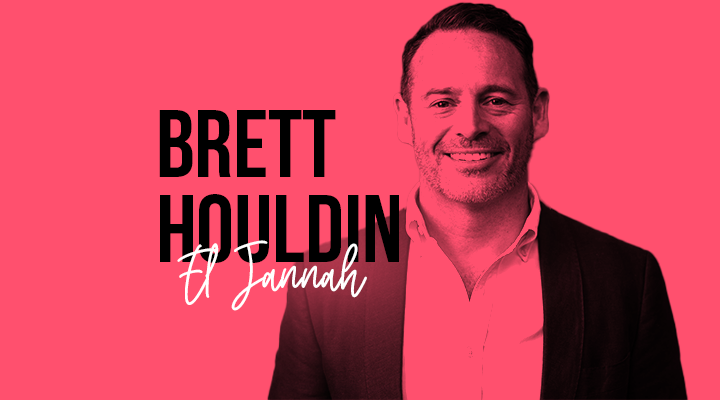
What is the secret to El Jannah’s success? CEO Brett Houldin discusses the brand’s evolution, and what’s next.
Brett Houldin has taken his skills to corporate and private equity firms, he’s worked with Star Entertainment, and for the last dozen or so years has made QSR – and particularly chicken – his world, first with Oporto and Red Rooster parent Craveable brands, and now with casual dining phenomenon, El Jannah. And he says he’s never had so much fun.
In this podcast Brett delves into what makes the Sydney-born brand El Jannah so popular with its customer base, and what has driven the family-owned business to make its mark in the highly-competitive QSR market.
“The difference that El Jannah brings is freshness and quality and consistency that we’ve been able to hone, particularly through our cooking methods in restaurant. But also the fact that we own the bulk of our supply chain, which means that we bring produce and our ingredients into store six days a week, which comes through our central kitchens.
“And that means that, yes, you could get similar ingredients or products elsewhere, but you’ll never get it as fresh El Jannah can make, which I think is what sets us apart and why people keep craving it wanting to come back more often.”
Building on heritage
Brett discusses the importance of balancing growth with staying true to the brand’s Lebanese heritage, shares expansion plans that take the chicken brand into new markets, and explains how El Jannah is engaging its customers.
The brand had a zero-dollar spend on marketing up until the last two years; now El Jannah is immersed in digital marketing and has invested in a brand-new app.
“If you look back at the heritage of the business, we effectively didn’t spend a dollar on marketing up until about two years ago. We really just used word of mouth and the product to do all the heavy lifting for us.
“El Jannah introduced a marketing fund in April last year…and that has allowed us to bring in top talent as well as, so that’s internally as well as an agency to support how we build on the brand story. We can drive transactions and volume and we can tell our existing and new guests all the reasons why El Jannah is better or different.
“Digital plays almost singularly the greatest channel impact of marketing for us,” Brett says.
He reveals more about the brand’s expansion plans too.
“As we keep building out, we’ll then be looking at some of the larger regional hubs, Wagga, Bathurst, Dubbo, Tamworth, Coffs, Port and Bendigo, they’re all on the map for us and we’ve got plenty of opportunities,” he says.
The founders and leadership team have ambitious goals for El Jannah; first a national, then international footprint.
“We want to be the world’s best, fresh casual, fast casual brand,” Brett says.
Show notes
El Jannah, which in Arabic means paradise or heaven, was founded by Andre and Carole Estephan in Granville, Western Sydney, in 1998. The charcoal chicken chain stayed a local success story for years, developing a cult following for its Lebanese-inspired food and hospitality.
The business was awarded a 5-star franchise rating in 2023 and in August 2025 it has 49 restaurants open.
Brett Houldin joined the business in 2020 after five years at Craveable Brands. Brett’s career started as an accountant at PwC; he joined Qantas, moved to News Corp, and then to Star Entertainment, where he ended his nearly five-year stint as CFO.
Craig Tozer worked with Brett at Craveable Brands, and was appointed chief operating officer in July. His experience includes Macquarie Bank, Rothschild, JP Morgan and almost seven years at Craveable, including four and a half years as Oporto CEO.
Craveable Brands is a chicken-focused QSR multi-brand business, managing the Chargrill Charlie’s, Chicken Treat, Oporto and Red Rooster brands.
El Jannah most recently expanded into Sydney’s Eastern Suburbs with a store at Randwick. Other recent additions include Tuggerah at the Central Coast of New South Wales, and Wollongong on the South Coast.