

Sarah
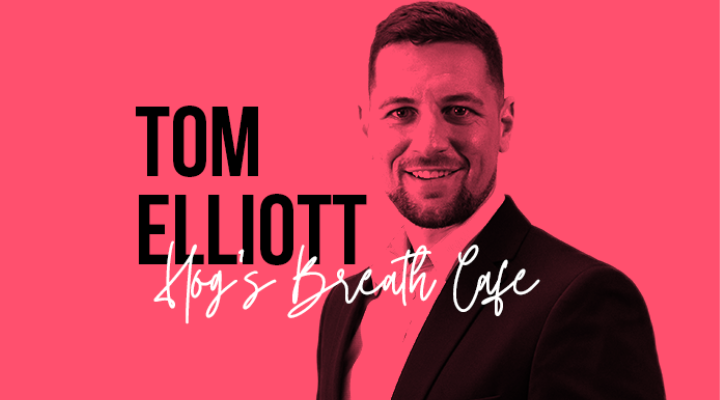
Tom Elliott has been in the hot seat at Hogs Breath for just four months after a 14 year spell at Retail Food Group. He’s got stuck into tackling the iconic brand’s turnaround, so it’s great to hear from him today about the strategy to return the casual dining brand to a premium position. Welcome Tom.
Tom Elliott
Thanks Sarah, thanks for having me.
Sarah
Tell us about Hogsbreath Cafe and why it’s been a loved brand. What’s the brand done right over the years?
Tom
Yeah, well I think Hog’s Breath first and foremost is one of Australia’s most recognisable casual dining brands. You know, I think the history of the brand has been built on sort of 36 years of heritage, very much known for its 18 hour slow cooked prime rib, obviously the curly fries which is a mainstay as well.
But I think what’s also sort of held in the minds of consumers is how uniquely fun it’s been, the laid back dining atmosphere that it’s had over the years as well. And the brand’s strengths really been in creating that nostalgia piece. And people remember coming to Hogg’s Breath for birthdays or family dinners, occasions after footy celebrations, those type of things. So we all know that the emotional connection in hospitality is gold. That’s where you’re gonna win or lose. So that’s what the brand I think has done right, as well as offering a consistently generous value proposition. So whether that’s portion sizes or sizes on the menu that caters for all ages, it’s positioned itself as a place where everyone’s welcome and no one really leaves hungry from a hog’s breath experience.
Sarah
So you’ve touched there on the emotional connection. I’m wondering what else makes a brand work in this market today because obviously there are certain challenges. You you’re sitting in a mid-market space, right? You haven’t got the speed and the convenience of fast food. You’re not fine dining where people are kind of necessarily going out for a treat. Where do you see, not necessarily hogs breath, but the market in general, where do you see that sitting overall?
Tom
I think you’ve hit the nail on the head, so mid-market is a challenging space. Customers can trade up to your point to a premium or special occasion. Equally, they can trade down to that fast casual or QSR experience when times are tough as well. So I think for us, what makes a brand work today is a clear and compelling reason to visit. And it’s not just that we serve great food because you can get that at many, many establishments, but we want to be the place that gives you something that you can’t get elsewhere. Now that could be a signature menu item.
It could be a different a cultural brand personality that people want to be a part of and want to engage with. So I think in the current environment, particularly for mid-market, it has its potential to focus on the relevance, the emotional connection with customers, and then delivering value that is beyond just price point. So whether it’s things like loyalty programs, you know, the experience that you get when you’re dining with brands, and then the integrated digital convenience as well. So I think the sweet spot for us is making guests feel like they’re having an occasion, so to speak, without paying a premium price for it.
Sarah
Does that in any way limit the potential? People, as I understand, are spending less now on eating out. That makes that more of a challenge, doesn’t it, for you, in terms of it’s not going to be the quick meal. It is going to be something that’s more of a treat. In times when people are economically stretched, that also must be a challenge, just the frequency.
Tom
Yeah, I think it’s an opportunity for us to evolve as a brand as well. So I mean, we’re doing a lot of work now in the back end of not just pigeonholing Hog’s as being a sit-down steak dining experience. And what I mean by that is the restaurants of the future will be very much bar-enabled and bar-led. With that becomes a different sort of menu category range in our appetisers that we can open up as well. So it’s about catering to the needs, I think, for all guests.
You talk about value, we offer our $16.90 ranges as well in the lunch space, which is quite a quick sort of in and out experience with Hog’s as well. I think it’s part of this evolution piece that we’re on at the moment is working out how do we transact with more guests more often, and that’s evolving as we speak.
Sarah
So just to take that step back, why does Hog’s Breath need a reset? You said it’s done lots of things right, but it has been in a bit of a slump, hasn’t it? It’s not been performing at its best. what’s gone wrong and why does it need a reset?
Tom
Yeah, well, I think there are a few sorts of economic factors that we have to take into consideration of over the last five years as well. We’re not the only brand to have suffered a decline in restaurant numbers or store numbers. In fact, there haven’t been too many brands that have been blowing the doors off as far as growing is concerned outside of a few of the main protagonists. So equally, there’s a brand that we have got that has been slow to modernise, has been slow to evolve, and there are plenty of opportunities for us to get that right as we move forward. I think when I came in, the biggest thing that Hog’s Breath has in its arsenal at the moment is a really strong brand awareness. But it has lost some of its cultural relevance. I think it’s fair to say. We’ve been too reliant on our heritage and we haven’t really kept pace with the shift in consumer expectations, whether that’s around menu innovation, digital convenience, brand engagement.
So the reset really is about modernising without losing what makes us Hog’s Breath because the brand has such a strong affinity out there in the market with consumers and guests, both frequent guests and lapsed guests. So for us, the refresh is more about balancing that. So balancing menu innovation, investing in digital ordering and loyalty, and as I said, re-energising marketing with a bit more of a disruptive and social media led approach.
That for us will help us elevate the guest experience we think across all touch points. And then expansion, we’re going to focus on quality over quantity as well. So strong performing franchise partners in strategic locations supported by a tighter operational model that makes restaurants more efficient and ultimately more profitable.
Sarah
So can you tell us a little bit there about the plans for strategic expansion when you say they need to be strategic locations? What are you looking for? How do you see that expansion shaping up?
Tom
Yeah, I think if you look at the model size historically, you know, we’re talking quite large format restaurants. 450, 500 squares are the ones that we’ve got left for the most part now. There’s a sort of a blend in there. We feel that we can cut down to a model that’s a bit more agile and a smaller model that can cater to different needs and different customer segments as well. you know, there’s that side of things from a restaurant perspective. There’s also back of house efficiencies around the kitchen equipment that we use, how we bring a bit more theatre into the restaurant as well, which we know is what customers want to see when they’re dining out and engaging out from a restaurant perspective. So I think the model needs to be fit for purpose moving forward and then as we grow I think being strategic around what we can service and what we can’t service as well, given that we’re primarily east coast-based at the moment and making sure that our locations are in high traffic, high footfall areas where con
Sarah
So when you talk about theatre, mean it’s something that is so important isn’t in retail at every level and hospitality. Is that about the experience? Is theatre about the experience for the guests? Is it about how they’re welcomed and is it about what happens at the table or do they need to see the kitchen? What do you see?
Tom
I think it’s the whole experience. I think it’s the case of whether you come into Hog’s Breath and everyone knows the memorabilia that’s on the walls. Some of it’s pretty funky, some of it’s pretty interesting, but the guest always remembers the memorabilia through to how you’re treated with your birthday and your dining at Hog’s Breath and how the Hogs the mascot starts to interact within each individual restaurant all the way through to, yeah, maybe I do want to see my 18 hour prime rib being cooked by the chef back there and I want the theatre around the flames and the noise and the ambience in the restaurant. So I think all those touch points need to be considered if you think about the end-to-end guest experience as you move forward.
Sarah
Where do you start? I mean, I’ve got a whole lot of questions here about, you know, specifics. We can delve into it, know, marketing and guest experience. But where do you start with this?
Tom
Yeah, that’s a good question. Yeah, I think a natural and a logical place for me to start was with the franchise partners and listening to them around the feedback that they’ve been getting from their guests, why they feel that their restaurants now are at 50 % capacity versus, you know, 75 to 100 % 10 years ago. And then getting some insights around, so from a guest experience perspective, what are we doing right? What have we lost our way on? And what are we not even sort of in the ballpark of at the moment because we haven’t innovated and haven’t modernised enough.
So I think starting with what’s happening at the coal face and you know why guests continue to come back to Hogs Breath and equally why they have not in a long time is really important so that you can start to road map a strategic plan and have your pillars in place to execute against that.
Sarah
So while we’re on that topic of guest experience, it’s so important, can you give us some idea how that might dovetail with say digital and system automation because that seems to be very much part of the experience now. On the one hand, it’s about experience and on the other hand, it’s about the convenience experience, isn’t it?
Tom
Yeah, I think if you look at restaurants now, I mean, there’s a couple of key factors that you have to consider and one of those would be back of house. So technology around cost of good management, inventory management, roster management, those type of systems and processes in place back of house so that I can repurpose labour at the front of house in a more effective way so that I’m meeting customer needs states around speed of service, product quality, and being able to amplify that guest experience I think is super important.
We know that digital ordering in our restaurants, we absolutely under-index in that space and that’s something that we’re looking at rolling out across all our restaurants quite quickly. We also know that guest transacts at a higher average spend with us than the traditional guests. So, you know, it make strategic sense to put a bit of a focus on that and bring the new generation of customer through.
Equally, you don’t want to lose touch with what has made this brand so well renowned over the years, which is great customer service. And in our business, it’s called Hogspitality. And our team members really wear that with pride, and our franchise partners embody that. And you don’t want to lose touch of that either, because that’s going to be really important for a lot of the customers as well. And I think there’s brands out there at the moment that likes a square that are really amplifying that service does still matter in the space that we operate in, I think that’s a really important thing to remember as you move forward into the digital age.
Sarah
Now you touched briefly on the model for franchisees. Hospitality, particularly now, attracting high costs. You’ve got rent, you’ve got labour, equipment, cost of goods. Where’s your starting point for providing a robust model? What do you look for? How are you going to shape this so that it’s appealing to franchisees?
Tom
Yeah, well think it comes back to what I mentioned just before around site selection and making sure that we’ve got a rigorous process for site selection. So that’s getting the right footprint size, number one, so that we can get the right rent to revenue ratio and get the location fundamentals right from day one.
We know what makes a successful Hog’s Breath restaurant in each demographic that we operate in. Then you need to focus on menu engineering, of course, to maximise margin while protecting your guest value perception. I think that’s really important before moving through to operationally how we standardise best practice across labour scheduling. We’re using the likes of Tandra in that space and inventory control. We’re using the likes of Suppy in that space as well, to name a couple of suppliers. So franchisees aren’t having to reinvent and we have this ecosystem in the franchise space that restaurants are buying into and making themselves more efficient so that they can spend time on driving the business and driving the front of house which is where we know that that’ll make the most difference for our business.
And then of course you’ve got marketing that needs to be firing on all cylinders that drives measurable foot traffic, integrates with the local community and local store activity and then I think you’ve got a robust model
across all the touch points that you need to make this restaurant chain and this brand chain successful again.
Sarah
Will you introduce smaller formats? It’s very much a trend for a lot of the fast food brands to look for kind of kiosks or the mini version. Is that something that would work for Hog’s Breath?
Tom
No, no, I don’t think that’s something that we need to go into right now. I think there’s plenty of opportunities to get back to sustainable levels of restaurants across both domestic and international. I think there’s been brands that have tried to branch out into different models and formats quite unsuccessfully. There’s been others that have done it successfully. But I don’t see the need for us to you know, move into whether it’s food trucks or you know, mobile vans or whatever it might be or kiosk type QSR scenarios. That’s not us. People want to come to Hog’s Breath for the experience. They want to sit down, they want to engage with the brand and they want to have a good time. And I think that’s best served in the format that we have just with tweaks to the model.
Sarah
So you mentioned marketing and you’ve had a brand career with strong marketing thread through it. So can you just share a little bit more about how disruptive marketing can help reestablish the brand?
Tom
Hospitality is a super competitive industry right so you have to cut through the noise and you don’t want to be another me too brand that same-same and a bit dull and a bit boring, that’s not going to get you cutting through the noise in a crowded dining space so you don’t want to blend in I think that’s point one.
Naturally for Hog’s Breath, we can lean into our personality a little bit more and be a bit more bold and cheeky in our communications and a bit irreverent. So I think there’s ways that we can make our marketing dollars work a little harder for ourselves and get back in front of mainstream eyeballs again. And there’s some campaigns that you’ll see hit the market before the end of the year that I think will make people start talking about us in a positive light again. That’s a bit cheeky, maybe a bit funny and a bit humorous in that space, leveraging off clever partnerships and collaborations as well.
Obviously, know, Jacked Up Ribs is a big promotion for us – that’s our partnership with Jack Daniels. There’ll be more in that space. We’ve just partnered with a cocktail brand which will bring mainstream eyeballs again back onto our business. We’ve got a retail and apparel brand that will launch towards the end of this year as well for our merchandising chain. So I think those collaborations with brands that are gonna bring it in mainstream eyeballs and also a younger generation that gets social media buzzing is really important.
And then you can sort of leverage that with high-impact above-the-line campaigns supported by targeted digital and whether it’s TVC and radio, whatever it might be. So I think it’s about creating moments that people want to share organically. And you can’t force that stuff on consumers. You have to earn the right to do that. And that’s what we’re working on in the background.
Sarah
You’ve been in hospitality for 14 years. I wonder what lessons you’ve learned from the various roles you’ve had and out of that what do you bring to this CEO role at Hogs Breath?
Tom
It’s a good question. I think the biggest lesson is that brands are built by people. It’s not just the logo that you slap in front of people. You can have the best strategy in the world, but without franchisee or without team member buy-in, I’ve seen execution falter. So I’ve learned almost the hard way that the only thing that really matters first and foremost is to listen and then lead decisively after that.
Innovation for me has got to be balanced with operational reality. Change for me is only successful if it works on a busy Saturday night at a restaurant level and the 16-year-old team member all the way through to the shift manager can manage what we’re trying to execute from a strategic perspective. So I think listening before road mapping your leadership style and your strategic plans is super important.
In the CEO role, I’d like to think that I bring an energy, a blend of strategic vision, marketing, creativity, but then also hands-on operational experience, which I think is kind of unique to this role. I understand how to engage with franchisees as true business partners, align teams, and then sort of roadmap that shared vision and move quickly in response to consumer demand. So I’d like to think I offer a 360 view to the role and how to move this business in the right direction.
Sarah
I’m wondering also whether the focus is very much on consolidation over a what period of time that might be before you start expanding and bringing in new franchisees. Is that going to be the strategy or is there a different approach?
Tom
No, don’t think we need to consolidate any further. I think naturally you’ve got some restaurants in any sort of cycle of the franchise agreement that will come to their natural end. I think it’s a mature conversation to have that with exiting franchise partners. Equally, we’ve got some really successful restaurants that are looking to change ownership now, which we’re helping our franchise partners with exit strategies right now. But I don’t think we need to consolidate before we start to push the button on expansion.
I think what I’ve seen over the first four months in this role is that there’s a lot of interest around the brand again. There’s an interest in bringing Hogs Breath restaurants back to the local communities that they once operated in. And now my role is to make sure that we’ve got the right model and we’ve got the right team to be able to execute against our growth strategies whilst looking for like-minded franchise partners in the hospitality space that are going to be progressive and are going to be good for customers, good for the brand and live by our values. So I don’t see the need to consolidate. I think we’ve got a very healthy base of restaurants now and a very good cohort of franchise partners to launch our growth plans off of.
Sarah
So what’s the big goal for Hog’s Breath for you?
Tom
Yeah, well I think, you know, the big goal from my point of view is just to make this business and this brand the most loved and most relevant casual dining brand again in the country. You know, that doesn’t just mean returning to growth by way of restaurant numbers, but I think redefining what it stands for in today’s market. I think there’s a stigma attached to the brand at the moment that it’s had its best days and it’s dying and maybe it’s not as cool as what it once was.
I think in practical terms it’s about modernising the experience, obviously expanding into the right markets with the right partners as part of that, but then re-establishing the cultural relevance so that a new generation of customers can fall in love with the brand like many of us did years ago. And that needs to be taken with a balance of, you know, we need to protect the profitability and the sustainability of the model and our franchise partners. But there’s plenty of opportunities out there for us and I can see us getting back up to 50 restaurants in the next five years. I can see us having multiple international territories as well through master franchise agreements because the brand is so well loved and well known in countries like New Zealand and then into Asia as well. So, you know, that’s really my goal.
Sarah
So what is it about hospitality? That’s been your career, so what is it that attracted you to hospitality and what is it that keeps you motivated on a daily basis?
Tom
Yeah, I think it’s the engagement with people, if I’m being honest with you Sarah. So, hospitality for me has always been about creating moments that people remember and, you know, my first role in hospitality was working behind a bar at the golf club and always remember you know how it made the individual or the guest feel you know when you’re serving them a beverage or some food and just having those chats that you do in the hospitality industry was something that always resonated with me and I think there’s something powerful about being part of someone’s celebration whether it’s a birthday or a special event or comfort because it’s their favorite meal prime rib curly fries or whatever it is in conjunction with that connection that you have every day in this industry. So I think to your question what drives me, I think the ability to be creative, I think the ability in this role which is a big commercial challenge, you know the ability to bring a brand back that many people believe has had its heyday to relevancy is something that’s a big challenge but one that I look forward to day in, day out. So I want to see this brand come back to life and I want to be able to serve many more Australians for many more years.
Sarah
Tom, it’s been great to hear about your strategy and your approach. We look forward to seeing you succeed over the years. Thank you.
Tom
Thanks, Sarah. It’s been a pleasure.
Hog’s Breath Cafe CEO Tom Elliott believes the best is yet to come, and he has clear plans to revive the iconic chain. Renowned for its slow-cooked prime rib steak, curly fries, hospitality and restaurant memorabilia, the 36-year-old casual dining brand is in need of a reset, and the new CEO believes he has the blueprint for success.
Hog’s Breath Cafe has a long history as a popular dining destination on the east coast of Australia, and it has a distinct personality amplified by in-restaurant decor and memorabilia.
However, Tom suggests, it has failed to move with the times, and that’s what he plans to redress.
“The biggest thing that Hog’s Breath has in its arsenal at the moment is a really strong brand awareness. But it has lost some of its cultural relevance, I think it’s fair to say. We’ve been too reliant on our heritage and we haven’t really kept pace with the shift in consumer expectations, whether that’s around menu innovation, digital convenience, brand engagement.
“So the reset really is about modernising without losing what makes us Hog’s Breath because the brand has such a strong affinity out there in the market with consumers and guests, both frequent guests and lapsed guests. So for us, the refresh is more about balancing that,” Tom explains.
In this podcast Tom explains his overarching strategy to give customers a “clear and compelling” reason to visit.
“I think the sweet spot for us is making guests feel like they’re having an occasion, so to speak, without paying a premium price for it.”
Tom talks about:
- navigating the mid-market challenges
- reviving a beloved brand
- enhancing guest experience and digital integration
- the franchise model and site selection
- innovative marketing strategies
- Leadership lessons and future goals.
Show notes
Hog’s Breath Cafe has traded as a steakhouse restaurant since it launched at Airlie Beach in 1989. A spate of restaurant closures in 2019 reduced the chain’s footprint and today it has just 21 restaurants, predominantly along the east coast in New South Wales and Queensland.
The original Hog’s Breath Cafe owners Don Algie and Ginger White trading as HBC Management bought back the Hogs Breath Café franchise system in October 2020 and appointed Steven Spurgin as CEO; he held the leadership role for five years.
Former Retail Food Group executive Tom Elliott took on the CEO role in May.
Tom was previously head of corporate store operations for the Retail Food Group. He began his career with the multi-brand franchisor in marketing for Brumby’s Bakeries before taking on the brand manager role. Tom then moved to sibling RFG brand Donut King, initially as brand manager role, then general manager.