
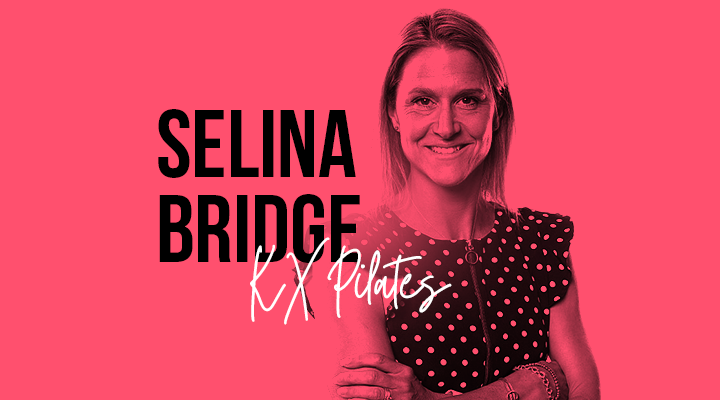
Sarah
Selina Bridge has been a leader in Australia’s fitness industry for more than 12 years. She brought her marketing experience to curves, then took on the GM role at the women’s fitness chain before moving to KX Pilates, where she has been CEO for nearly eight years. Selena, welcome to the podcast.
Selina
Thank you for having me, Sarah.
Sarah
Now you grew up and studied in the UK, long way from Melbourne. I wonder what your earliest influences were.
Selina
Goodness me, early influences, and I must say I’m feeling old because I’m trying to sort of cast my mind back. I’ve got to say I’ve actually just recently lost my mum and I didn’t realise just how much of an influence family are and just where you how you grow up and the kind of behaviours that you naturally just learn and absorb. And I guess as a parent that’s something that that I’ve been reflecting on as well. So for both my parents, they’re just hard working people.
so when I grew up studying, whether it’s at school or then going on to university, it wasn’t really having a particular goal. I wasn’t in you know, exactly sure what what I wanted to be. Definitely being the CEO of KX Pilates was not on the radar when I was at school, had no idea. but it was more around ethic, you know, just trying to do my best, whether it was for exams or for sports, always showing up, being committed, working hard, seeing how I could improve myself. So yeah, sort of being where I am now, I reflect back on just those early behaviours that have then taken me through just everything that I’ve done. And at school, just I just enjoyed such a range of subjects. I’ve always been into health and fitness and sports. And again, probably a little bit of influence for for family. So I always enjoyed that at school. Never thought I’d be in the fitness industry, didn’t realise you could actually have a career in that. But you know, how how sort of life takes you on different paths have have ended up following a a passion there. So yeah, I think it’s sort of just just those you don’t realise the influences that that are there when you’re growing up.
Sarah
What’s been the guiding force then behind your career choices if you didn’t start out with a particular goal?
Selina
Yep. I think there’s there’s definitely been and I I feel that word force has definitely always been a a guiding force and it’s very much from within to say my heart and what I feel passionate about because I know I do well when I’m passionate about anything that I do. I went to a really great university and I did a business degree, I did well and I had really great opportunities to work in a a number of different businesses and industry and I was going to work for a
Top accountancy firm when I had finished. But it was when I was traveling and talking about what I was going on to do, it didn’t feel authentic. It didn’t feel from within my heart that I was following the right career. So I did feel a force over a better direction, something that suited me more. And when I was traveling, or when I came back from traveling, I actually ended up resigning from that role before I started and just started to look for something that felt
more like me. So I have sort of always taken this internal instinct to where I feel connected to a brand or a project or a business. and that has been my that’s actually been my story throughout my my whole career. I’ve never gone for a role because it sounds good or I think it will make me look good. I’ve gone because I genuinely am really interested to work for that company or that purpose. And then it’s funny how you you’ve sort of work very hard or you work well when you’re doing something that you’re you’re connected to.
Sarah
So you said on another podcast that you followed your partner at the time, who’s now your husband, to Australia. All kinds of things bring us here. What was your plan at that point? When you left the UK, you came here. Did you have a plan?
Selina
Well Yep. So again, I sa I I I was gonna say I sound very unplanned. no, or I did know I didn’t want to leave the UK because I absolutely loved my I was in my early stage of career. I I was working for a sports sort of consultancy agency and I absolutely loved what I was doing. Really, really exciting work. and it was a great time of life. I actually didn’t want to leave the UK, but I also know knew I wanted to
Be with my partner, I was quite excited about the idea of having some time in Australia. So, like a lot of English people came here for two years, but that’s twenty years ago now. So again, didn’t have the plan, and sometimes that’s probably quite good because if you’re so fixated, it could be it could be very overwhelming. The idea of leaving the UK forever, or if at that time leaving for twenty years, I probably wouldn’t have done it. Whereas when you leave for opportunity and try and sort of take each day as it comes and and enjoy the experience. That’s where then the experience grows.
Sarah
So you’ve worked across a number of major brands in marketing. What have you learned in your marketing roles do you think that contributes to your perspective in business today?
Selina
Gosh, you know, marketing has changed so much. Obviously, over the years, it’s just grown and grown. And I do remember, it shows then my age. I remember when digital was just like a small percentage of consideration as everything you’re thinking about. so marketing itself has changed, but I guess the fundamentals are are there. It’s marketing’s really there to build a connection between both prospective clients and business, and then obviously those who are already part of your brand.
It’s very much about storytelling, creating emotional connections. But I do know that it doesn’t matter how good a marketing campaign can be, if the product or service does not meet that expectation, it doesn’t matter. So that’s what we always say. Marketing’s not there to fix a business, ever. It can be there to help a business stand out and definitely in a very competitive space, it’s really important, but it’s never there to fix a business. At the end of the day, the business, whether it’s a product or a service, has to be what it says on the tin and meet the expectations of the client and one bad review as we know or one, you know, negative reputation undoes all of that brilliant marketing work.
But again, I think connection with brands, you can you can sell I hate the word sell because I I feel like I never have to. When you’re connected to something and when you believe in something, that’s where marketing really is is magic.
Sarah
So tell us about KX Pilates and why you’re so passionate about the business.
Selina
Mm-hmm. Gosh, and as you said, I’ve I’ve been there for nearly eight years and it still feels quite new. it’s actually been the longest or the my longest tenure of of a workplace ever. and yeah, very passionate. I think the reason I joined KX because the role was almost a similar role to my previous role. I was really inspired by the fact it was it was at that time a smallish brand with a lot of growth potential.
The founder and his wife, so Aaron and Andy, are so passionate about the business. I could just feel that there was genuine care to make this a really great business and brand. And that passion and interest is is absolutely still there. And I think that comes when you have a privately owned business because the founders in there, it’s not just a business, it’s very much something that everybody cares about.
So again, with it we we sort of joke within KX, there’s a lot of emotion within the business, whether it’s within HQ or then our franchise partners, but it’s because people really care. and that’s that’s makes it a really exciting place to work. It can be very challenging. You know, the people are the the best part of the business and then they can make things very challenging as well because it’s there’s so much at stake. But a very passionate, purpose led business with opportunity. You know, we we don’t stand still at all. There’s probably a lot of work that goes on.
We’re always looking at how can we better ourselves, how can we make the client experience better, the trainer experience better. And, you know, franchise in itself is an interesting one. We all that that word has so many different connotations to it. But at the end of the day, it’s creating so much opportunity for people who then genuinely want to own a KX business. And that’s really rewarding. The the the business side of KX is really rewarding as well.
Sarah
So before we kind of talk a little bit more about the business side, I’m interested in any advice that you might have for someone replacing the founder as the CEO, because that’s always, it’s always a challenge, isn’t it, for the founder to let go. So any advice?
Selina
You probably have to ask Aaron that. But look, we I I’d almost say we’re quite lucky because I don’t know how other businesses have gone, whether it’s been easy or hard. And I know it was a little bit hard before my time with Aaron. And he was obviously still very early on in the business being able to let go. We have and I say Andy as well because Andy, his wife, is so connected and so important in the business, but we’ve I think between us there’s just a good relationship, mutual respect, we challenge each other sometimes. We can all agree. A lot of the times we can’t, or it might be two against one. I just absolutely respect the fact he has built this business. I’ve never come in to try and completely change it. I do have to add value, otherwise, why have me there? But I I very much respect his and Andy’s contribution in the business.
So I think respect, trust, and obviously alignment it’s really important that we’re aligned. If if Aaron had brought me in and I was starting to take the business in a completely different direction, that wouldn’t have worked. So I think there’s been luck as well. Yeah, we we do just generally we all really sort of think very in a similar enough way that we can move the business forward together. But said may maybe that’s lucky. I don’t know how other businesses have gone with that.
Sarah
So KX Pilates is one of the earlier brands, I guess, to bring in the reformer Pilates model of Pilates. And that’s just going gangbusters, isn’t it, really? And I want to talk about the customer’s experience in a moment. But I’m just wondering, from just an overview in general, in this Pilates landscape, what does the business need to do to stay ahead of the competition?
Selina
Great, you know, great question because there is a lot of competition. I call it choice because at the end of the day we’re it’s choice for the the consumer and you just want to be able to have give consumers or clients, we call them clients choices, and you hope that our our offering is what they’re looking for. We also know that KX isn’t for everybody, so you can’t just expect everybody to come to KX. It’s great people have choice, but like relationships, you know, it’s good that people like different things.
But yeah, the more competitive it gets, it actually means we have to keep sharpening up. And as I said, it doesn’t matter, yes, we’re trying to do more marketing and do things in a different way. But at the end of the day, is the service good enough for that client? If they’re choosing us, are we giving them what they want? Are we also giving them what we say we’re going to give, you know, personalized experience? We’re very human-led, we’re not screen-led, so that trainer is so important in our studios.
The quality of the workout, the connection, everything there just has to be really good. and even within our KX network, here we do mystery shopping or we do all sorts of sort of audits and checks. Yeah, I’d love to say everyone’s at 100%. That they’re not, there’s always room for improvement. And when the competition or when the choice, when there’s a lot of choice, that’s the opportunity to make sure are we delivering the best possible experience? So to stay ahead, we’ve just got to really keep working hard. And I think people feel that it it is a
It’s a hard time of industry. You can’t be complacent.
Sarah
So things have changed since KX was introduced. And you’ve talked there about your client experience. How have members’ clients’ changed over the years? And what’s valuable now in customer experience?
Selina
Do you know what fundamentals haven’t changed? People like to be seen and valued. They appreciate connection. They appreciate being, you know, corrected, perhaps if you’re doing a move which isn’t quite right. And that the value of a trainer coming to correct a movement or again just sort of acknowledge a client is still so, so important. So that actually hasn’t changed the fundamentals of great service.
But you know, at the same time, when there is a lot of choice and people might go to a studio which does have a different, well, a different service offering or a different lounge experience or different partners, of course, it starts to make clients go, that’d be nice if we had this here as well. And in our world of what what we noticed a few years ago, of course, with a subscription economy, people just sort of expected to have subscriptions and just easier ways to pay, quicker ways to book. So it’s almost the influence just in general of how digital and technology is just changing, in general, everything that the way we live, that filters through.
We’ve we’ve got to keep up with the technology from a booking system or a marketing contacts and are we quick enough? It’s all of those will change client expectations. We don’t want to fall behind because then a client can think, well, you know, that the brand’s not up to speed. So yeah, so I think it’s it’s a multiple other other Pilates brands or fitness brands will drive expectations of what is premium, what is what does good service look like, what does value-based offerings look like.
And then said outside of the fitness industry or just be in general, c consumers, like how we actually interact with booking and marketing, that’s all changing. So we’ve got to keep up with that too.
Sarah
So the business has quite considerably and it’s gone international as well.
What are the key elements do you think of actually successfully scaling a business? It happens to be a franchise model, so that’s obviously one way, but what’s the fundamental to get right?
Selina
And I think you have to ask yourself, do you know, you or any brand has to say, well, what does success mean? And for us, success, well, hopefully Aaron still agrees with this. But you know, success isn’t necessarily about having the most, the highest number of studios. And I must say, I personally do cringe if I see brands talking about how much money you could make in a studio or just dollars. We are not about the dollars. We’re about the client experience, the partnership with our franchise owners or our master owners.
So success to us is getting the right people on board who can align with the brand and just keep fueling what KX is all about. So for us, finding the right partner is just hugely rewarding because then it means that we’ve we’ve all, you KX is safe. Like we’ve, we’ve, we’ve got the brand and what we stand for and the kind of quality of experience is going to be carried on by that partner rather than just saying, yeah, we’ve we’ve sold five and then see what happens. So in our world, success is the right partners. And then through that, we will definitely grow. We love being able to offer KX to different communities.
And as I said, the actual business opportunity when that person comes along, it’s so rewarding when you’re going through an interview and they’re so passionate about wanting to have their own KX business and being able to offer the KX experience in their community. That’s so rewarding to be able to award those rights to a a franchise partner as well.
Sarah
So how important is that passion in comparison, say, to having a sense of business and having the ambition to grow and understanding the numbers? Because if you don’t get those right…
Selina
Yep. Yeah. You’ve definitely got to have that. And I think we have seen that over the years, which is, you know, great. A lot of a lot of clients do become franchise partners, but then they are typically people who are changing careers. Yeah, we’ve got lawyers or we’ve had you know other entrepreneurs or people who are already in a
Career, but then changing to then take their passion for KX and then run a business. Like that, that really is a perfect blend. Of course, saying that a franchise model is there, we’ve we’ve done a lot of the hard work, whether it’s the research or then the training and the systems that that people buy into. So there’s absolutely an element of if the passion’s there and the hard work and the ethic is there, that person can learn a lot within a franchise model and certainly within within KX because that’s the whole point. We do set up people for success. So it’d be ignorant to say you don’t need to have any understanding or desire to learn how to run a business because it is a business and it’s not just a passion project. It does have to to work. But like it’s a bit like employing people. That work ethic or the alignment is so much more powerful than just hiring someone ’cause they’ve got a a good C V.
Sarah
So how would you describe your leadership style? Because at the end of the day, you’re pulling all this together with a team, but you’re driving it.
Selina
Yep. As as you can see, I mean, I I would say I I love working with people. My leadership style’s anything but I’d say anything but egotistical or my way because I genuinely love the ideas that we’ll get from the team. I like seeing people grow and evolve and giving them opportunities. So I feel like I’m I don’t know, I guess my style is to try and bring the best out of everybody. You know, I can see
Everyone within the company has got so many positives to them, and everyone, including myself, will have limitations and challenges. But that’s we’re we’re all human. So being able to bring people together, and as a team, you can work through those limitations because someone in the company will have the you know, the the strengths and the capability. So my style is really trying to get the team, get the right individuals within me, like within the team. People who are better than me, I’ve got a subject, you know, everyone’s an expert in their areas. I am not, so I haven’t actually been in a marketing role now for years, well over eight years, probably 10 years. I have a marketing team. so just I respect, I bring in experts, I want them to be the best version of themselves and contribute to the company. So yeah, I think for me it’s it’s definitely not about me. And I said it’s it’s I respect an Aaron and Andy, but likewise it’s just about making sure we’re bringing out the best in our team. and also same with franchise partners, that mutual
Respect is is really key.
Sarah
Have you been influenced by any situations yourself or any people in leadership roles that have formed that perspective?
Selina
Yes. Yeah, look, if I look back on my career again, the companies where I have then been the best version of myself have been where I’ve been I’ve got good relationships with the leaders. They’re not and this is my very first role and then another you know, another agency in in Australia as well. But where the leaders are definitely not there and just making everyone do exactly what they say quashes all kind of thinking and innovation and passion, because you’re just doing what they say. I’ve the roles where I’ve be I’ve wanted to grow and evolve and prove myself is when there has been that leader who encourages that. so yeah, look, I guess that’s and that’s that’s where I’ve done well and I guess that’s my natural style because I want to be able to do the same as well.
Sarah
So how have you faced up to challenges in your own career and handled any failures?
Selina
Yeah. And that’s the thing. There are there are failures to say all the time or you you talk about it, there there are learnings. And fact, you know, even even personally, go going through a lot sort of personally recently, you just realise every single experience you go through is always a learning. How can you be better as a result? within KX, that there’s been decisions we’ve made. It might be, you open up a studio in Queensland thinking this is gonna be the this is gonna be the flagship, this is gonna drive
the business forward and then it didn’t and it you know cost a lot of money to do that. At the time the thinking was right, circumstances changed. I guess you can’t hang on to a failure and stop you from wanting to try new things. It’s just what can you learn from that and apply it to the, you know, the the next decision going forward. So I I’ve got a lot of resilience. I do find that I reset, which is good. I I can find I reset quite quickly whether or not it’s
It might be a a difficult conversation with a franchise partner or it could be just, yeah, just challenging times within a team. It’s really important to be able to find the learning and then be solution orientated and move move forward.
Sarah
So what drives you on a daily basis?
Selina
I guess I I think I do like whilst problems are really challenging and no one likes the problem, I do like solving problems as well. So and I shouldn’t say problems, I like complex challenges. So whether it’s yeah something something personally or or at work, the desire to try and solve a challenge and then feel the sense of achievement and then be able to move to the next. So I do I I do thrive on that. I’m not someone I also like a bit of I I don’t want to say chaos, but I know the word chaos gets thrown around the company. I don’t mind when there’s something new and excit I like it things being dynamic. So that gets me out of bed sort of thinking, you know, what are we facing today? And that’s that’s business, I think. And I have been in a business before where it’s been a bit too predictable. And it’s very difficult for me to get motivated by that. So I like a bit of uncertainty. I like being able to, yeah, sort of see see what comes up in the day and and try and work through that.
Sarah
And what’s the biggest lesson you’ve learned in business?
Selina
Well, again, I think and this is life, you know, there’s just not one right way. Ever. You know, there’s not one right person, there’s not one right way, whether it’s your own learning, as I said, that example of a a studio could be right next year. From a people side, never feel that just because you could have a dominant person they can give that impression that they are absolutely right and no one else can, you know, ever be right. It’s just not true. We’re
Certainly business and certainly humans, we’re all a collection of individuals with as I said lots of different ideas and strengths. I think being able to just back yourself. And for me, I’ve got to back myself and think even if I might disagree with someone else, doesn’t mean that I’m definitely right or they are. It’s it’s being able to be confident and be authentic because then you feel comfortable in the decisions that you make and then the teams that you lead. Because if you’re backing yourself and being true to yourself.
That I mean, that is the right way.
Sarah
Just to finish up, it’s a tough economy at the moment. There’s a lot of uncertainty in the world.
There’s AI throwing all kinds of chaos onto the scene. People are still looking either to set up their own business or to buy a franchise. What’s your best piece of advice for a would-be business owner, someone that hasn’t tried this before, hasn’t run a business?
Selina
Well, and again, like it when I’m saying there’s no right or wrong, the world and everything just keeps moving. And if someone expects today to be the same in three years’ time and you’re setting yourself up for failure, you’ve got to expect there’s going to be change. You’ve got to expect there’s going to be challenges. You’re absolutely right right now. Someone else quoted from a different industry, but we agree. It sort of feels like COVID times again. It’s like, ooh, it’s it’s pretty, pretty tough.
But If you’ve got the fundamentals of backing yourself, making sure that you are at you you’re prepared to work hard. I think prepared to learn. Just don’t stop learning. Be open and interested in AI or be open and interested in what the competition or what’s going on in industry. Because it’s not going to change in future years that we we’ve got to still do that as well. So I think don’t be put off and think, suddenly it’s all really hard to be in business because you look back over the last so it’s always been hard. It’s just the parameters of what we’re working, the conditions keep changing.
But if you’ve got those fundamental said work ethics, desire to grow and learn, I think being able to people around you is so important. That’s why franchising is really powerful. And when franchise partners get it right and they realise they’re part of this brand with so much learning and actually together you can have such impact rather than trying to just battle it through on your ow, that’s very, very powerful. so look it’s at the same time, it’s very exciting.
You know, business is exciting. I know that our business is gonna have to keep changing and it’s changing quickly. not necessarily the service, like we’re really focused on trying to maintain for us as the actual product. We wanna stay very human led. We don’t want to be the robot business, but we’re all having to upskill and learn new skills and how does AI help us in business? And that that’s pretty exciting.
Sarah
It’s been great to have a chat and just hear a little bit more about your perspective on life and business. So thank you, Selena.
Selina
Thank you for having me, Sarah.
With over 12 years of leadership shaping Australian fitness brands, KX Pilates CEO Selina Bridge understands the foundation of premium service remains unchanged: great fitness experiences are built on human interaction.
However, driven by the rise of the subscription economy and frictionless everyday apps, today’s clients demand rapid booking systems, hyper-convenient payment methods, and elevated lounge spaces.
In this podcast Selina discusses what it takes to keep a premium brand ahead of the competition. Fitness operators must relentlessly innovate their technology and marketing pipelines, ensuring their digital sophistication matches the high level of care delivered on the studio floor.
Show notes
KX Pilates was founded by fitness entrepreneur Aaron Smith. He launched the first studio in Malvern, Victoria, in February 2010 after discovering the dynamic reformer Pilates concept while living in London.
Today, the boutique fitness franchise has more than 100 locations across Australia, New Zealand, and Southeast Asia. This year the goal is to reach 115 studios.
Selina Bridge joined the business as CEO in 2018 after four years in leadership roles at Curves, and a career in marketing.
Earlier this year KX relaunched its KX Signature program to create more options for clients, unveiled an Active Recovery program in response to the wellness trend, and added KX Strength to focus on more traditional strength training.