


Sarah Stowe
So Danie, welcome, great to have you with us. Tell us a little bit about your career. You’re now with Ready Steady Go Kids, and I’d like you to tell us about that in a moment. But first of all, just can you tell us what your background was, where your career was heading, and perhaps what your expectations were at the time?
Danie O’Connor
Okay. Yes, it certainly wasn’t in the career I ended up in, that’s for sure. I went to university and I have a commerce law degree, always been interested in starting my own business.
really know what that would look like. So I took a graduate role at the Australian Taxation Office and when I was with them I completed my Master of Tax and I just used that as an opportunity to soak in everything, learning all facets of businesses and how business structures worked and all that sort of thing. I used that as my learning tool knowing that I would eventually exit the ATO. Yeah so that was where I started off and it wasn’t really
Ready Steady Go or franchising was not on my radar at all. Obviously I love kids and I love sport but that’s not where I was headed but did have that interest in business.
Sarah
So when you say you knew that you weren’t going to be with the ATO, you kind of had that idea that this would be a set of tools that you would be able to take into business in some form.
Danie
Yes, and just learning from that other angle what is required for me as in setting up a business structures, all those sorts of things, legal requirements. And so I thought the ATO would be a perfect way to start. And it was really interesting. I worked in the high performance or the high wealth individuals department. So I learned a lot of really tax avoidance tricks, actually. So it was it was really inspiring. it was and at that point, I didn’t want to leave, to be honest. I was really enjoying my my career there. Yeah.
Sarah
So what was the catalyst then? Why did you shift from that kind of tax focus to joining a kids’ multi-sport franchise?
Danie
Well, it kind of just happened because I had children fairly quickly. So 2006, eight and 10, I’d had three kids under four, first two being boys and just active little kids. And I just needed to get some energy burnt off. So I did a bit of Googling for them to burn some energy. There wasn’t really anything around, but there was Ready Steady Go Kids but it was half an hour away so we my husband and I joined the two older boys and we made it our Saturday morning thing we just went half an hour travel and played at the park and had some lunch afterwards and and we just really fell in love with the program thought it was we saw the improvements in our own kids from being shy little one particularly my second one shy little little boy to just you know really confident and and his gross motor skills he had some delay so his gross motor skills really through Ready Steady Go Kids.
And so it wasn’t until I was on the phone re-enrolling at one point and I just made the comment to the lady on the other end of the phone to say, hey, it’d be really cool if you had something a little bit closer. Is there any plans? To which she said, well actually we’re looking at franchising. Do you know anyone that could run this program closer to you? And I’ve got, I just made a joke, said my husband would be perfect at this. And then hang up the phone thinking nothing of it.
And got the phone call from the owner’s at the time to say hey you know we’d really be keen to talk to you and your husband and at that point I wasn’t wanting to leave the ATO I was on maternity leave but I was planning to go back there the public service obviously has got lots of good leave there in entitlements so I wasn’t looking to leave at that point and then so 2011 all of a sudden we had bought two franchises it was yeah
Sarah
So you bought two in one go.
Danie
a two-in-one go. We were the first franchisees, one in Sydney, another franchisee in Sydney, and we’re the first ones in Melbourne. Yeah, so I just thought this could be an idea of starting a business from scratch with full plans on my husband being the coach, but being an electrician, it never worked out that way. was just that I ended up being on court and I loved it so much that it then just became my business.
Sarah
So I’m just interested because you’ve obviously had all that business experience. People buy franchises quite often because there’s a security element to it. There’s a risk minimization, right? They’ve seen that it works with other people. There are systems in place. You were the guinea pigs in a sense. Yes, the system existed, but you were taking that chance and taking two territories.
So were you anxious about that? What did you kind of bring to that, do you think, in terms of research or about the business? How confident were you that your skills would be transferable into their systems?
Danie
Yeah, look, to be honest, there wasn’t a lot of systems in place at the time in the franchise business and they were very open with me to say that we want to work together and they actually did like my skills and thought that I would be a perfect person to help them get set up. So we looked at local area marketing guidelines together and I was kind of their guinea pig and they were my guinea pigs. So we kind of learnt at the same time. I’m a bit of a researcher, so when this opportunity came, I did look into franchising and I actually thought, well, you know what, rather than go fully on my own and have the full responsibility being a part of a franchise where you know you’re buying the brand it’s already established and it was at the time very well known in Melbourne it was there were head office company owned locations I knew the program was was was developed by a physiotherapist so I knew it had the credibility and then I just thought oh I can do this I can take my skills and implement implement them into into a franchise I said what have I got to lose
Sarah
So you must have had some challenges though. what initially, what were the challenges for you as a franchisee?
Danie
I think my expectations, I think because I had three kids in the target market. I had a four-year-old a two and a half year old and a newborn baby. I was in that target market So to me my first instinct was how hard could it be to get 30 kids to come to a class if I set it up on? On a Saturday a couple of classes, you know, I know more than 30 kids, of course, you know They’re come and do my classes and that was a real That was a real culture shock. It was it was I just expected that they would come and it took marketing It took hard work. It took brand awareness because as I mentioned, we weren’t really in my
So people may have heard of it, but they may not have experienced the program. So it was all about building that brand awareness, which I had had no experience doing at all. So that was my biggest challenge, just getting the word of mouth out there.
Sarah
You mentioned at the beginning that you really like the program. Can you just tell us a little bit about it? It’s a multi-sport program. Can you just tell us a little bit about the concept?
Danie
Yeah, so basically we do 10 sports over two terms. So every fortnight we change sports and it really gives the children the opportunity to learn the sport and then practice it and then recall it in the second week. So they’re getting that they’re creating that those brain memory pathways. And I just love that we got an opportunity to try different things. So, you know, we would have naturally just gone into Milo cricket and AusKick programs, but being able to be exposed to hockey and golf and t-ball and things that we never would have been on our radar, it was just really great. And you could see the hand-eye coordination that the kids were building up and just those gross motor skills. It was definitely the variety of sports that I loved about it.
Sarah
Now your transition from a very structured organisation with ATO, again helping to create some of the structures with the local area marketing as you say. What did you learn about yourself in that transition from something that was very well established to as an employee to becoming a franchisee and in a sense helping to drive that business as well? What did you learn about yourself?
Danie
I think that the ability to move from such a structured, process-driven environment to then adapt to be, you know, show initiative, resilience, adaptability, you know, I had to do my own problem solving, I needed to build my own systems.
And I really enjoyed that part. I enjoyed the business growth. I enjoyed helping other people succeed. My neighboring franchisees, when they came on board, I enjoyed helping the franchisor at that time, know, build the business together. You know, so it was just that switch from very structured to be able to, right, this is, it’s me and it’s me only. I’ve got to do this. I’ve got to work this stuff out for myself. It was great. I loved that part.
Sarah
You’ve moved on within Ready, Go Kids, but you’ve had quite a journey. Can you just tell us about that journey, about where you were and where you are now?
Danie
So I started my first franchise in 2011, Term 3, with the two regions as I mentioned. By the end of the first year I had 50 kids in each of the regions, so 100 kids in total, which I thought was pretty good. The franchisors thought that was pretty good. So then I just got a taste for it and I thought, oh I wonder whether I could just sneak into this area and so I ended up buying a third region in 2012. And then I won franchise of the year in 2013. At that point we started
getting more franchisees on board. And by 2014, after my fourth child, I had six regions and it was just crazy. It was more than a full-time job, particularly with the four kids at home and school and all that sort of thing. But I just thrived at it. The more I did it, the more I loved it and the more I wanted to be better and build better things to make things easier.
So that’s kind of where I headed in 2014. I became really close with my neighbouring franchisee, Sherrie Boulter. We did a lot of training together. I actually bought two of her regions off her and I took her on board to become my training manager. So we kind of worked together. Yeah, so she was, because I had the four kids at home, she was out and about viewing classes, making sure the staff were doing the right thing, training. Whereas I was doing all the back end of the work, the payroll, the rostering, the marketing, all those sorts of things. So we worked really well as a team. And then in 2015, the owners basically said, we’re done, we want to move on, we wanted to get as many franchisees on the ground as we could. Now it needs a bit of management, the franchisees need some love and care, and that’s what we’re not.
we’re not in the business to do and said to Sherrie and myself, you like to buy the business? And we kind of looked at each other and said, we’re crazy not to, this is the next step.
Sherrie’s come from a HR background and accounting as well. So we had a good complement of skills to take the next step. And that’s what we did in July, 2015.
Sarah
So that’s quite a leap, isn’t it? I mean, it sounds quite a leap, although you’ve obviously, you kind of built a substantial business at that point. And I’m assuming that when you went into this as a franchisee, that wasn’t your goal. You didn’t think that this was going to be where you ended up, right?
Danie O’Connor
No, it wasn’t. No.
Sarah
But you’d managed to establish, so did you have six or eight at that point? So you had six regions, four kids, it was all kind of established. But again, taking that on, how many franchisees were there across the network at that point?
Danie
Six regions, six regions, yeah, yeah. By the time we took over there was 23 and…
it was I was actually friends with all 23 so when I made the leap from franchising to franchisor that was even though it was easy because they they had trust in myself because I had you know done these these these projects with with head offers it was also a little bit you know how do you break that there’s a fine line between business and friendship then so that was that was quite difficult to then navigate as well
Sarah
Did you have a particular technique there? Did you learn anything about how you kind of handle that kind of shift into much bigger leadership?
Danie
I think the franchisees, well my neighbouring franchisees or the franchisees in the network at the same time as me, they did, they were so good. just, I think they really appreciated someone taking over that had been a franchisee before. I know, well I knew what they were going through, I knew how to help them, I knew the pain points, I knew what the struggles were. So I think they appreciated someone in the network taking over as opposed to an external coming in and having to start again and not really understanding where they were at, even though the franchise model was quite new.
Sarah
Did you have any instances where there was a bit of pushback because they were expecting you to have more of a franchisee handle or perspective and you’re looking at it from a franchisor and a growth perspective and asking them to step into an area or do something that they’re not comfortable with? Did you have a bit of pushback? Have you had to navigate any of those situations?
Danie
Yeah, look, it was really interesting. We took over on the 1st of July 2015 and we had our first annual conference on the 7th of July and we had all prepared, we’re prepared what we’re going to do, but the franchisees all thought that the previous owners were going to be running this conference. we, that was announced on the 1st of July, we turn up as the new franchisors to run the first annual conference on the 7th of July. And we were just, we, we, we opened the night with a cocktail night and it was questions, you know, what do you want to know? What do you what you know? And we had a vision and we had a very clear path of where we wanted to see the franchisees and we’re really focusing on their internal development as opposed to, you know, bringing on more franchisees in to really focus on their individual improvement.
So I think that was the the bridge where we kind of had that face to face group environment where they had the opportunity to hear what our vision was, ask questions, and it really opened up the communication pathways that way. I think that really helped.
Sarah
It sounds as if the two of you were managing that quite well and you had a clear sense of what was, I’d like to know what your vision was at the time and what your strengths were other than being a franchisee. What strengths did you bring to the role of franchisor?
Danie
Yeah, I think because the previous franchisor their job was, and they made it very clear that they were in it to sell as many franchises as they could to get the brand as, you know, widely known as they could and then they were out. So they had made that very clear. So I think our vision was that, okay, that we’ve had a period of high franchisee intake and now we really want to focus on really improving the individual performance. So let’s get some local area marketing guidelines, which I previously worked on, let’s really focus on our marketing and improving their marketing in their local area. know, what hiring their coaches and their staff, really putting importance and supporting them around documentation and all that sort of thing with hiring their own coaches and really improving their individual performance so that they’re, you know, they’re feeling like they’re just not left and we’re going to be just, you know, adding franchises in and forgetting about them there on their own. We really wanted to make them feel like they were supported.
We implemented some KPIs around enrollment numbers and all those sorts of things and had some trial conversion rates and re-enrollment rates. We implemented all these sorts of KPIs so that the franchisees had something to aim for. But it was getting to the point where, you know, our KPIs for enrollments were a hundred per region. But what franchisees weren’t understanding that, great, I’ve got my hundred enrollments for my region, but they’re offering you know 14 locations and 25 classes and what they didn’t realize well the actual break-even point wasn’t that they weren’t covering their costs.
Yes they had their enrollment goal but they also needed to look at their trial conversion goal and their re-enrollment rates and and really being able to know how many kids do they need in each class to actually cover their costs and that was a really a big eye-opener for Sherrie and I particularly because you know that was instinct to us we knew that the first thing we needed to do was we needed to know how much our hire was and our wages so that we knew what our break even or our cost coverage point was so that we knew, you know, we made decisions about, well, we’re not keeping that class because I’ve only got two enrollments in it.
Whereas, franchisees we were seeing would run small classes that weren’t actually covering their costs and they didn’t really realize it was hitting their bottom line until too late. So that was one big thing. And I still harp on that you know, till today, every franchisee, we’ve worked through the break evens for each location, each class with them every term. And I encourage them to do it weekly so they can track their numbers and not just numbers, what it means to their back pocket because we all love kids and we all love sport, but at the end of the day they need to feed their families and cover their bills. So they need to be making some money out of it as well.
Sarah
So other than that kind of financial understanding, what do you think are the keys to small business success?
Danie
Definitely consistency. being, and I’ll go back to a marketing example, you have to consistently market. And that was something that, you know, back when I started as a franchisee, the talk of the town was you need to hit someone three or four times with your brand before they actually make that purchase decision. And, you know, as the years have gone on, it’s now almost up to eight touch points that they need to see before that call to action. you know, parents, particularly because we’re in the preschool age group, they want testimonials, they want credibility, they want that mum to mum sort of recommendation for our brand. that was really important to be able to be recognised as a creditable brand and get our testimonials out there and have people talking about us because that’s our best referral source for new customers.
Sarah
How do you manage that with franchisees? you in, I mean, local area marketing generally is up to the particular franchisee. It’s obviously a little more complicated with the digital assets. How do you manage that side of things so that you are ensuring the message is correct, but also that it’s being driven in the right way?
Danie
Yeah, digital marketing is really tricky because once it’s out there, it’s really hard to take back. So we’ve implemented things like Canva Teams where we’ve uploaded our brand guidelines, our colour tones, our fonts, our digital images and all that sort of thing so that the franchisees have got some really clear templates. And, you know, I want to talk about enroll now or enrollment start on Monday. Here’s your six templates that you can use on Canva Teams. You can change the picture or you can change the colour of the font to one of our other brands colurs but just sort of to keep that give them a guideline of what they need to do digitally but it is super hard because you know we all want to get creative and we all want to do our own messages you know bring it you know writing that in you know sometimes I feel like my full-time job could easily be just making sure our franchisees on social media are doing the right thing.
Sarah
Now, you and bought out Sherrie, is that correct?
Danie
No, so Sherrie’s retired. So she’s still a silent partner and I do catch up with her monthly. We’ve kind of made our own little board meetings every month.
There is a plan for me to purchase her out.
Sarah
So how are you finding being the sole franchisor?
Danie
I love it. Not that it was not good with Sherrie either I’ve got a clear picture of where I want to go and I just do it now. So I feel like my direction has become a bit clearer.
Sarah
I want to talk about direction in a minute but I’m just wanted to kind of focus very briefly on franchisees and what you look for in a franchisee.
Danie
Yeah, really good question. It’s hard one because you know there’s never a silver bullet with these franchisees. The ones that look amazing on paper, know, sometimes don’t turn out the way we thought they would. So I want someone with the personality to be a team player, to be able to fit into our network. So I’m really looking for someone that really loves sport, really loves kids, is a team player, is wanting to learn and wanting to contribute to a larger network, because that’s what we’re all about. I think the strongest thing about our brand is our fabulous franchisees that just work together so well and they collaborate so, so, consistently and nothing’s ever too much trouble to help each other out. So I’m really looking for someone to fit into that mold.
Sarah
Yeah, makes sense. Are they predominantly parents of small children themselves?
Danie
Yes, yes, I reckon I’ve got probably a handful than are not parents. But yeah, we’ve got a mix of different career paths that have come into franchising. So I’ve got a lot of teachers. We’ve got a lot of childcare educators and directors, which is amazing because they’ve got so much insight into the ELC world. We’ve got a couple of corporates.
Yeah, so we’ve really got a good mix of, they’ve primarily chosen our business or our franchise brand for the flexibility of homework lifestyle. And it’s just brilliant for that. It is the perfect mom and dad business or mom or dad business because you can be there, you can structure your classes around school drop-offs and school pickups and after school activities. It’s not your traditional nine to five, you know, sitting at an office desk franchise. It’s a really flexible model.
Sarah
So you mentioned ELC there and that probably ties in a little bit with my other question about the potential of the business but can you just explain where you’re doing your courses, where do you do your programs? Do you find venues? Do you go to centres? How does it work?
Danie
Yeah, so we’ve basically got four income streams for franchisees. Our main one is our classes. So we deliver classes at indoor sports centres, basketball stadiums, community centres. So it’s up to the franchisee to go and have a look in their local area for community spaces and to hire that hall for the duration of the classes. Our weekend classes are by far the most popular.
Our second income stream is ELC Incursions where we approach the ELC director, offer our sports incursions program and then we go and deliver the program in their child care centre.
That’s really a really big income stream at the moment in New South Wales; other states haven’t quite taken off. We also do birthday parties so we have a lot of birthday parties going on each weekend mainly, there’s not many during the week and then holiday programs so running little sports sessions through the school holidays because obviously our classes are term by term scenarios so being able to have that income stream during the holidays if franchisees want it. Not a lot of franchisees do things on the school holidays but it is an option for them to do. A lot of our franchisees like to spend the school holidays with their kids which is why they bought the business in the first place. They’ve worked hard that 10 weeks with the term and then they’ve got their two weeks off to spend with their own little cherubs.
Sarah
I just wanted to end up asking you about the potential for the business because I mean I know that this is a brand that is overseas. Maybe you can just touch a little bit on its reach but specifically then kind of pull back and say okay well where can this business go in Australia?
Danie
Yeah, so we are in 26 countries internationally. The international branch, Sherrie and I did sell off to Brent Kelly, the founder of Kelly Sports in 2018. So it’s in amazing hands. So Brent deals with all the international countries.
So he’s still expanding out there. We do the training with them, with the internationals. So we do get to meet them and talk to them about master franchising and what have you. that’s really, really awesome.
But in Australia, which is my domain, and this is why we got rid of international because it was just, we feel like we had our fingers in too many pies and we really just wanted to focus on what we’re really good at Australia.
What potential do we have? I think we have not even opened the surface of ELC incursions. think that’s where people, where our franchisees are headed and that’s their individual direction. I think particularly with the cost of living, where our weekday classes have been normally very busy. Mum and dad have had to go back to work an extra couple of days because of the cost of living. And we now find those children who were normally available to come to our classes during the week, they’re now in childcare.
So that’s where our target market is coming. So childcare incursions is going to be the next big thing for us I think. And then really repositioning our brand as our tagline ‘more than just sport’. So the sport is the part that sells for parents. Everyone loves their kids to do sport, particularly in Australia, we’re a very sporty nation, but it’s then retaining them with what their child is actually going to get out of the classes. So they’re going to get their gross motor development. We’re talking about bilateral coordination and physical literacy and school readiness. And so we’re really trying to educate our coaches and our franchisees to then impart that those skills and those knowledge of what we’re actually bringing to the children into our classes each week. really my vision is to really upskill our franchisees and coaches on that language about, you know, those occupational therapists, you know, what are the benefits of our program beyond sport and really have them imparted to the parents so that they can see true value in our program. We’re not just playing sport yet, that’s the fun part and it is a fun class, but they’re actually learning, you know, when they’re doing tennis, they’re actually strengthening their wrists and their shoulder and that’s a precursor to be able to write when they go to school. So really just having those relatable conversations with our parents of, you’re not here just for sport, we’re actually, you know, getting you ready for school and the world and life in general.
Sarah
Danie, it’s been great having a chat with you today. Thank you so much for your time.
Danie
Thank you. Thank you so much. Thanks, Sarah.
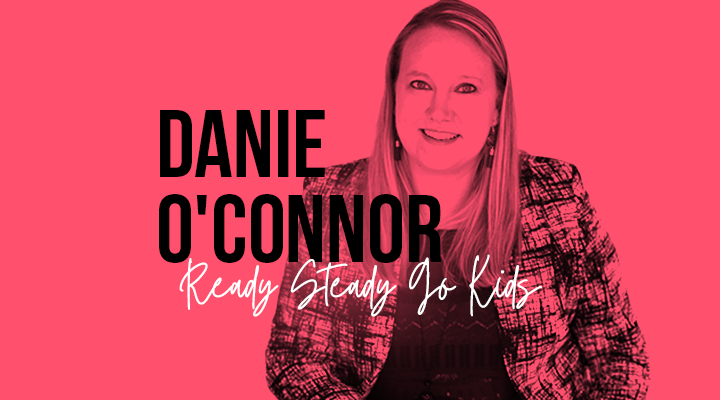
Danie O’Connor began her working life in the Australian Tax Office – a role she loved. So it was a big surprise to find herself suddenly taking on two franchise businesses so her young children could have somewhere to enjoy the Ready Steady Go Kids multi-sports program close to home.
After jokingly volunteering her electrician husband for the franchisee role, Danie then found herself stepping up to the business, and flourishing as her own boss.
She admits there were some surprises in the early days.
“I think because I had three kids in the target market (I had a four-year-old, a two and a half year old and a newborn baby), my first instinct was ‘how hard could it be to get 30 kids to come to a class if I set it up on a Saturday? I know more than 30 kids, they’ll come and do my classes’.
“And that was a real culture shock. I just expected that they would come but it took marketing, and it took hard work,” Danie says.
In this podcast, Danie shares her journey from being one of the first franchisees in the Ready Steady Go Kids network, to building a mini empire of six territories, and then partnering with a neighbouring franchisee to run the whole business.
Today Danie is the sole franchisor, and relishing her role, and the capacity to make her vision a reality.
She reveals why the brand has so much appeal to both franchisees and customers, the multiple revenue streams, the scale of the international business, and her priorities for the year ahead.
Show notes
Ready Steady Go Kids launched in 2004. Today there are 45 franchisees operating across Australia.
The program has an international footprint, now handled by Brent Kelly, who founded the kids sporting program Kelly Sports in 1994. The brand is represented in 26 countries, including China, Indonesia, Italy, Jordan, Mexico, Singapore, US and Vietnam.
Danie mentions ELC – Early Learning Centres – as a revenue stream, particularly in New South Wales. These are childcare centres for kids up to pre-school age.