
There is much more to pool care as a business than the traditional image of a man-in-a-van. With the right structure and business model, a mobile technician can scale up to a substantial operation, in a sector awash with potential.
Australia has one of the highest rates of pool ownership per capita globally, with more than 3 million people in Australia living in a home with a pool or spa. And those pools need constant care.
“The pool industry is a nugget, and many people just stumble across it,” says Andrew Walker, chief of franchise development at market leading pool care chain Poolwerx.
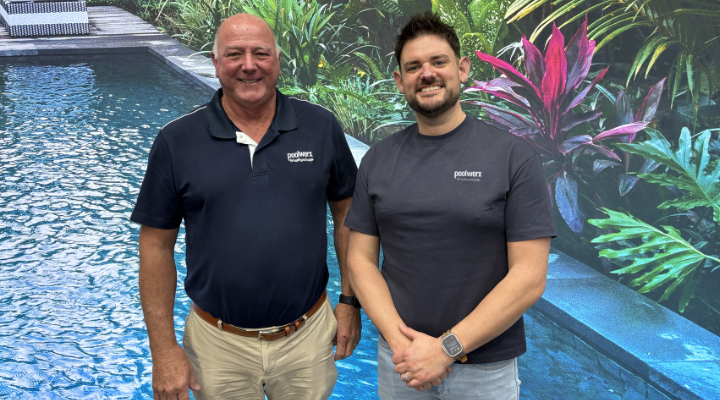
Choosing the resilient pool care sector was a “no-brainer”, for former car dealership boss Brent Townsend.
“What was evident is that people are time poor, and in an economic downturn, pool care is the last service they want to cancel. Pools are a piece of IT, they are complex operations,” he says.
Pool care is a resilient industry
Andrew backs this up; pool care is not a discretionary spend he says.
“Pool owners can’t cut out pool maintenance. During Covid we lobbied the government to list pool care as an essential service,” he says.
“We read the market closely, and can pivot, as we did in the GFC, and in Covid when we created drop and go boxes for customers to pick up and drop off chemicals and water tests.
“This is a sector that is both recession and AI resilient, and Poolwerx is a business that can be easily scaled,” he says.
Poolwerx is a hub and spoke model: retail stores are the base for service vans to operate their technician services. It’s a model that cleverly captures two customer profiles.
Seventy per cent of pool owners undertake DIY pool care, which means they need the chemicals and equipment available through a retail outlet. A mobile business can then attract the remaining 30 per cent of pool owners who rely on a pool care service.
Poolwerx offers opportunities to scale
It was this diverse revenue stream and opportunity to scale that attracted Brent.
“There are not many businesses similar to a dealership where you have income from showroom sales, workshops, selling parts and labour, and servicing,” he points out.
He placed a high value on the hub and spoke model which enables franchise partners to draw on operational efficiencies, to convert retail clients into service customers, and to scale.
“It gives us more potential, to centralise fixed services, and open a non-branded warehouse for bulk purchases. With more technicians and more stores, staffing is easier,” he says.
Poolwerx also stood out in the market, for its professionalism, investment in people, and its approach to recruiting franchise partners.
“I liked the accountability, the layers of interviews, reference checks, and that they want to see your work history. They know who they want in their network,” he explains.
What the best operators do
Brent and his partner Dale Hallas have flourished in the business they purchased in May 2025.
They own and actively manage a busy retail store in Mt Eliza and three exclusive Poolwerx territories across Melbourne’s south-east: Mt Eliza, Frankston and Mornington Peninsula.
“People would be surprised at how much we make. We have a profitable business,” Brent says.
There are a number of crucial factors contributing to this: operational efficiency, expertise, and culture.
“It’s getting the most out of your rostered staff, treating them with respect, knowing the customer’s pool. You need to be good at scheduling, and to maximise efficiencies. We invest in equipment, good vehicles with storage; we are reliable, and create a good working environment,” Brent says.
Franchise partners and technicians learn their skills at the Poolwerx pool school, Andrew explains. The initial franchise partner training program is four weeks, when they gain technical, business and operational knowledge.
This is followed by the Forming Good Habits 12-week program and further support comes with weekly monitoring by the management team.
In a sector typically regarded as seasonal, winter at Poolwerx is development season – a time when franchise partners work on their business. The franchisor provides training workshops, as well as technical excellence and retail excellence programs.
“We are a trust-driven brand. Trust and knowledge rates high among customers because of our skillset,” Andrew says.
How Poolwerx provides support
Brent adds that franchisor support is always available, as much or as little as is needed.
“If you are struggling, Poolwerx encourages you to put your hand up, and will guide you to the right path,” he says.
Brent initially joined the Poolwerx Family Welfare Group, which provides care and support to franchise partners, their families and team members during times of need.
“Now Dale is in the welfare group and I am in the regional advisory council representing Tasmania Victoria and South Australia, and a committee member of the Poolwerx Advisory Council,” Brent says.
The councils are an opportunity for the franchisor to get fresh perspectives from the franchise frontline, including feedback on pilot programs.
Poolwerx likes to be challenged, he says, and has a collaborative approach to its franchise network.
“The franchisor’s approach is not ‘This is how, just do it’. It’s rather ‘How will this go down? Have we got it right? Is the message right? Are there benefits?’” Brent says.
Andrew points to the revenue base and depth of business across ANZ and US, which enables Poolwerx to invest in new initiatives ahead of the curve.
“We can see tech development from a US lens, and bring these to the Australian market,” he says.
Brent likes the franchisor’s mindset.
“The common trait of the best operators is being number one but acting like number five. That will keep you number one, and that’s what Poolwerx does,” he says.