
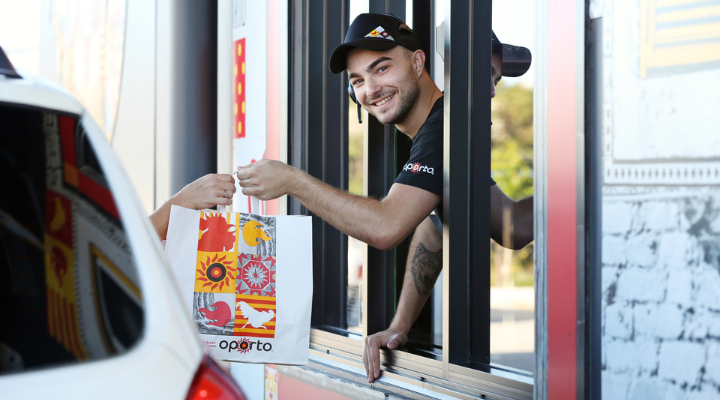
Buying a high-profile franchise like Oporto can give the new franchisee a brilliant start in business. But it is more than the branding itself that delivers competitive advantages, as head of operations Deborah Ruka explains.
“Many people want to open and own a business but lack the capacity to build the tools and systems required. Franchising offers built-in expertise so franchisees don’t have to start from scratch,” Deborah says.
Oporto is constantly improving the processes and systems so franchise partners can more easily operate and grow their businesses.
“As head of operations, my responsibility is to make it simple,” Deborah says. “Tools and systems can be complicated, but at Oporto we make them accessible and visible in real time. Our systems are easy to use so franchisees can be agile in their business.”
A comprehensive suite of business tools ensures franchisees can easily access the data they need to make smart decisions. That could be for inventory management, understanding past or forecasting future performance, or scheduling labour.
Integration is crucial for a seamless workflow
Integration is key, Deborah says. “Franchisees need to spend time growing their business by delivering a great customer experience, not navigating multiple systems. Providing an integrated flow enables the franchisee to manage their data seamlessly.”
Workforce is the biggest challenge for a franchisee, she points out, whether attracting good people or managing payroll and rostering.
At Oporto, the integrated systems smooth the whole employment process for franchisees. When recruiting, they can use the built-in psycho-analysis and automated candidate ranking to cut through the admin and identify the top candidates to interview.
And where once franchisees would need to manually collect visas or working rights documents from prospective employees, now the streamlined system enables candidates to upload the necessary documentation themselves.
“Franchisees can recruit staff and the information flows into the Tanda workforce system, then into MYOB for payroll, and then the ATO for Payday Super; it is actually a seamless process,” Deborah says.
She believes it provides franchisees with a level of confidence the data is input and the process is followed.
“The system has taken care of it because the automation won’t allow progress if information remains unfulfilled. Of course this doesn’t take away a franchisee’s personal responsibility, but the systematic process provides peace of mind,” she says.
When data is more than numbers
The Portuguese-inspired chicken chain has focused on delivering valuable data analysis, not just numbers.
“When looking at sales data, you can go down a rabbit hole,” Deborah says. “The key is to take data and make actionable, useful recommendations.”
One of Oporto’s tools is a Balance Scorecard which benchmarks performance. Franchisees can use the data related to their situation to strategically scale their business. Whether franchisees operate a shopfront, food court or drive-through store, they can view like-minded stores’ performance and see their business in the context of the broader network.
The Balance Scorecard includes customer feedback, standards review, like-for-like sales performance, loyalty performance and the mix of sales.
“This helps franchisees gain a whole picture of the levers that are important to pull in their restaurant. If you look at any of these data sets in isolation, you don’t see the full picture. This holistical perspective enables better and faster decision making,” Deborah says.
Continuous improvement is essential
Oporto has an ethos of continous improvement, which she believes to be crucial in the age of AI.
“One of the things to understand is, if you aren’t moving forward and learning new opportunities for tech you can quickly fall behind,” she says.
“At Oporto we are always striving to improve. We look at the data points and work out what we need to improve on, and the data guides us on brand strategy and marketing,” she explains.
Oporto benefits from synergies in its parent company, Craveable Brands, which operates four fast-food chicken brands.
“We can leverage Craveable Brands’ expertise,” she says, citing the advantages of scale in equipment purchasing, for instance.
“Equipment is a massive cost, so if we can unlock a scale of procurement to benefit franchisees, that’s a huge advantage. And across our four brands we can scale the cost of building and building materials when opening new stores,” Deborah says.
Leveraging brand power
As a multi-brand powerhouse, Craveable can also provide a resilient supply chain.
“We focus on contingency as a way to minimise the risk. As an example, let’s take a mayo made with eggs. We look at our supply chain and consider where we can source an egg-free mayo if there’s an egg shortage. Our agility creates surety for our franchisees,” she explains.
The Craveable team focuses on relationship building with suppliers to cement supply chain resilience.
In store, franchisees can easily manage their inventory on the Macromatix platform. It enables them to understand where food costs lie and where there is wastage.
Real time data also reveals day part trends so franchisees can see whether burgers or wraps, for instance, are selling better at any point in the day, and work out how to leverage this.
“What is crucial for franchisees is that all this automation and real time data removes a huge amount of time they could spend on admin,” Deborah says.
“Think about the cost of time to do these tasks manually, and then think about where, as a franchisee, you want to spend your time. You need to be where you can make money – serving customers and understanding business pain points, not buried in manual process.
“Technology is evolving quickly and both franchisees and the franchisor need to adopt a continuous improvement approach – whether that’s for kiosks, delivery or back-end systems. At Oporto, as technology advances, we embrace it, and learn how to use it to our advantage. That’s a real benefit for franchisees,” she says.