


Sarah Stowe
so Costa, tell us how you started out in business and why hospitality was the right career move for you.
Costa Anastasiadis
I was raised in a Southern European family and like most Southern Europeans, hospitality was really at the forefront of everything we did growing up. My parents were actually publicans and they had a pub in the Southern suburbs of Sydney. So I grew up ⁓ in a very rowdy pub.
⁓ where my parents also were crazy enough to run a bistro. So my love and passion for food really started from a very young age where I was amongst it and exposed to running multifaceted hospitality venues. So my parents ran a bistro by day, nightclub by night. They had all the perks of any pub, so the gaming was a part of it as well. ⁓
And in the sort of 90s and early 2000s, was really tactile kind of, you know, promoting nights ⁓ for a very specific target market and being a part, being exposed to that. So I just got exposure to the hospitality sector from a very young age through my parents.
Sarah
Did you feel that there was no other choice? Not that you were forced into it, but was it just inevitable that you would go down that path?
Costa
Well, my mother thought I was gonna become a doctor. I don’t know what made her think that because academically I was never strong enough. ⁓ But I think my parents tried very hard to steer me in another direction, in a completely other direction actually but it was too strong, the force was too strong. you know, it was, ⁓ I felt like I belonged completely in hospitality. just, ⁓ I loved the diversity of it, I loved the unpredictability of it, the social element of it was like a drug, it was addictive. And so I think my parents knew there was a really high chance we’d all of all segue into this. I’m one of three. My brother and sister followed suit as well. it’s for whatever they may have wished, we all ended up in hospo. So there you go.
Sarah
You created the crust gourmet pizza business and you sold it to Retail Food Group. A couple of questions around that. Firstly, how do you build up a business from scratch to one worth I think $41 million? And then secondly, how do you know when is the right time to move on and sell the business?
Costa
Yeah.Yeah, it’s a great question. I don’t know if there’s a real playbook to scaling. don’t know whether… So we never had delusions of grandeur with crust. was never, let’s scale this to 140 locations around the country and look for a liquidity event. It was far more organic than that.
I think circumstances are very unique and I think in hospitality you see ebbs and flows in trends and things that are on trend and in vogue. It just so happened that people were longing for great pizza and we’re probably talking around 2000 and like around the early 2000s.
And because I had exposure within my family business, we kind of had an idea of what was good, what was really good. And it was a very organic process, It was exactly that. was, let’s open up a store in the inner west suburbs of Annandale.
I had family that had businesses in the area and we knew it a great sort of had a great vibe, had a great energy about it. And it was just about providing great pizza for a local community. And that’s really how that happened. The momentum that we got after that is a different story. We soon discovered that people ⁓ were longing for quality.
people, mean traditionally back in the 90s, you would go into the majors and everything would be made behind closed doors. And we just had an idea about bringing everything to the consumer visually, a feast. So you would come in before a shift and you would see a front make bench and it would be pole high with smoked ham and freshly cut mushrooms and capsicum and onions and prosciutto and bocconcini and all the beautiful things that we’re used to today that you can get at any supermarket. I mean, this was new for a lot of people. And what was even more impressive was that they were seeing the ingredients for the first time. But that answers your first question. Your second question around, I guess, selling? that?
Sarah
Yeah, how do you know when is the right time? So you build it up, said you didn’t have particularly big ambitions when you started.
Costa
Yeah, so I mean, it was a 12 year journey. And I think the momentum after the first five or six years, there was a real momentum behind what we were doing. What I will say is exiting a business is very unique and is very personal, right? So I mean, we know families that have had businesses for generations that won’t. And you gotta remember I was 22 at the time, so was quite young. And so 33 or 34, when you have an opportunity to exit and you have a lot of interest in the business, it was appealing. And I guess the what also makes it quite unique is that it’s a bit of a high. So you think, you know, I’ve built something up and someone’s actually prepared to pay me a tangible amount of money for this. And there was things that were happening in the family and our experiences around uncertainty and some hardships we went through which kind of thought, we thought it’d be maybe a good time to take some chips off the table. And really it was quite personal…
we’d never set out to build a business and sell it. So was a lot of things that happened at a personal level, you know, with us, our partnership at a family level that we thought, you know, this could be good time. So that was really, that was really it.
Sarah
Did you find it hard to let go emotionally of the brand?
Costa
I think in the early days there was the high of a liquidity event and potentially setting yourself up. But I think in the…there’s always a sparkle every time I drive past one of my, one of the stores, I still call it mine, it’s not mine anymore. Every time we walk, we drive past the store, you often think, geez, I wonder what could have been, did we maximise the potential of the business? Would it be any different if we were running it now? ⁓ So there’s always an emotional attachment to the business, but I mean, you know, we’re big enough and ugly enough to get on with it.
Sarah
So as you mentioned when you were answering that question, there are companies, family businesses that don’t sell and some founders do stay with the business they’ve created for decades. Others like yourself sell up and explore new ideas. Since then you’ve obviously developed some new things. You’ve delved into gluten free space. ⁓ You founded Zeus Street Greek and you’ve taken the meals into a new distribution area, supermarkets. So what’s your strategy with this? What’s driving you? ⁓
Costa
Okay. So I guess I did segue into manufacturing for a little while. ⁓ That was really interesting. I always had a fascination with manufacturing in Australia. ⁓ So it gave me a very good understanding in how the major retailers behave. ⁓ And so when you look at Greek and you look at Mediterranean across Australia, although we have a significant Greek diaspora in this country, it’s fair to say that on scale, it’s a fairly new category. So when you look at Greek and Mediterranean, there’s really no one that’s scaled what we’ve done to the point that we have. And so the strategy behind, I guess, when you look at in-home dining, it is a growing category. And whether that’s because of cost of living or whether it’s because people genuinely prefer to cook at home, it is a category.
And when one of the biggest retailers in the country is showing a real, I mean, these guys are quite ambitious to grow the brand with us in a retail sense. ⁓ It feels like we could reach people in parts of this country that we don’t have access to right now. So whether you’ve got consumers in Townsville or Cairns or Albury, mean, all corners of the country, it is a great way to make the foreign feel familiar.
And then of course with that, we will follow that on with the bricks and mortar store strategy. And we’re seeing this. I often conduct site visits and negotiate leases. So when I’m out looking at new leases, I’ll go to the local Woolies and I’ll see how our products displayed on shelf. then there’s consumers are picking up our product and walking out the door and then little do they know that we’re looking at building a site within the same asset. ⁓ we believe that ⁓ it’s a great strategy to build brand awareness. ⁓
But we also think there’s a lot of potential in the meal kits and the at home category. It really plays into our vision of being Australia’s most loved Greek food brand. So beyond just bricks and mortar stores, for us, having a presence on shelf is very, very important and plays into the vision, the greater vision of the business.
Sarah
What gives the brand, what gives this street Greek a competitive edge at the moment?
Costa
I grew up at the local Greek tavern. My parents would take me to the local Greek tavern or it would be the local takeaway shop that was serving gyros or in Melbourne, sousas as they call it. ⁓
And so there was nothing in between and there’s a real affinity to Greek style barbecue because Australians love to barbecue. we noticed very early on that people connected with our produce, the product, the offering. ⁓
I think definitely the link between the Aussie barbecue and the Greek style barbecue, there’s a link there. you know, I guess bringing the accessibility of Greek food is interesting because up until we started, ⁓ where would you go for Greek? there probably wouldn’t be many places at a casual level you could dine at.
So.there’s a real opportunity and being entrepreneurial sometimes opportunity borders on delusion and you kind of believe your own hype. Fortunately, we have weathered the storm and there’s definitely appetite for Greek Mediterranean and there’s no regrets.
Sarah
And what do you think you do right? Because there are a number of other, perhaps smaller brands, and obviously there’s the local taverna. What is it that you get right? you think, is it cost? Is it access?
Costa
Well, think accessibility is really important and also we break down barriers. So we’ve almost Australianised the authentic and tried to remain true to our roots and our heritage, but to make it accessible to places where you would never think Greek would be popular. ⁓ And so it’s a combination of ⁓ the modern take on Greek, the traditional take on Greek, morphing the two together. And, you know, of course, you need to follow that up and ensure that quality is where it needs to be, service is where it needs to be. But there’s more people choosing Greek today than ever before. And we’d like to think that Zeus has played a ⁓ role in that. consumers palates have definitely shifted. ⁓ There’s a sea of burgers and Mexican and chicken and pizza at the market. I think Zeus. Not I think, I know Zeus, it balances up a category where you’ve got a lot of saturation in a couple of major categories and people are looking for diversity for sure..
Sarah
So how challenging is the hospitality industry right now with cost of living, cost of goods, etc. And I’m wondering if there are what you do to, or what franchise, what food businesses can do to boost profits, increase your profits.
Costa
Yeah, yeah, it’s a real challenge that, I mean, the sector’s being plagued with issues. ⁓
probably well before Covid hit. Look, rising costs and labour costs have forced everyone in hospitality to really look at their business in ways they could never look at before. The key for us is, I guess with scale, the one benefit for us is that one of the competitive advantages is that we can lock in supply chain. So in some ways, we’re not negotiating, you know, 100 kilos of chicken, we’re negotiating, you know, pallets and tonnage of chicken on a weekly basis. So our supply partners have our very best interests at heart. Managing cost of goods gives us a slight edge. What I will say is that with scale, we’ve also been able to, and there was some great learnings at Crust, I guess investing in systems to manage things like labor.
And with the help of, I guess, with the advancements in technology, especially around AI, we’ve invested heavily. So we can actually now develop, we can support our franchise partners to actually almost predict labor flows based on trends. So, you know, what’s really important is that franchise partners and restaurant managers are managing their labor based on what’s happening in a life scenario. And you every point helps. So from managing cost of goods and supply chain to managing labor, really.
I’d say that there’s also been a real emphasis on the way we build these stores. We want to make sure that our capex isn’t blowing out. I mean, know, building, cost of building generally has gone up by about 30%. So we’re always looking at efficiencies in our cook line, in the way we build these stores because it really, I mean, in the end, this is a commercial business, right? So we’re not, we love what we do, but we’re not a charity. And for us, return on investment is key. So keeping our construction costs at a reasonable level based on what we need are really important. And, you know, we’re scrutinizing every dollar we spend within these businesses.
Sarah
You’ve talked about franchising, and Crust obviously, once you’d set that up, became a franchise. And Zeus, I think, from probably close to the beginning, has been franchised. What is it that you like about the model?
Costa
Yeah. Well, I mean, ultimately, franchising is about creating wealth for people. And there’s there’s something honourable in that. I mean, it can’t go the other way. And we’ve seen examples of that where it’s happened, but we won’t get into that right now. But ultimately, what we do is back ourselves in corporate stores. We prove the model. And then off the back of that, if feasible, and it has been, we look to roll out the franchise model. Growth and the ability to scale is much easier with great franchise partners. We came into the world of franchising with Crust by default. It was never our intention to be, we were 100 % franchise with Crust actually. We didn’t have a single corporate store.
Today, we look at things a little bit differently. We think there’s real value in holding a cluster of corporate stores. And of course, franchising allows you to grow at a relatively healthy rate. You wanna maintain quality of product and integrity of brand ⁓ and then recruiting great franchise partners takes time. But it does allow us to go to places we could never go to. For example, we have a couple of great stores in Perth. mean, it’s easier to get in New Zealand, right? And we’ve got amazing growth opportunities in Perth. And the same is true for South Australia and Adelaide, where we have a couple of stores opening up, and of course, South East Queensland. And as you get further up Queensland, it’s harder to run corporate stores. So there’s a real place for franchising in our business.
Sarah
On that topic of growth, what about international?
Costa (19:02)
Yeah, I mean, you know, we get it’s really interesting. We’re almost 12 years in and we’ve hit a threshold. We’re almost at 50 stores and the level of inquiry coming into the business is quite high. The biggest challenge with international is ensuring you’ve got the right partner.
We’ve done this before and we had a tricky time with Crust. We actually opened up a store in Singapore and we actually, not many people know this, but we actually opened up a store in the US, in Los Angeles. Yeah. And it was, guess our youthfulness and we were quite naive at the time thinking we were gonna take on the world from a single store in Annandale.
We quickly realized that these could be money pits and really big distractions. The international expansion is certainly one that we would consider at the right time. We think it’s really important to solidify ourselves in the Australian market. We’ve got a long way to go here and by no stretch of the imagination are we near done. But
It’s the truth is that we attempted with a conversation on international, you know, quite frequently. And we’ve strategically put that on the back burner for the time being.
Sarah
What do you see as the key measures of success for the business? The AFR reports that the business will be $120 million in revenue this year, I think. How else do you judge the success of the business?
Costa
Yeah. Well, look, mean, success for us is continued growth while maintaining our core objectives, right? So it’s really important we continue to engage with our current customer base while growing brand awareness.
Having a national footprint is critical for us continuing to improve the unit economics of the business. know, continued margin expansion, year on year percentage growth. I mean, if we’re talking about the economics of the business, that’s really important. But at a personal level, for us, educating consumers on the Hellenic cuisine and Mediterranean diet is really important. mean, it’s our heritage, like we’re very proud Australians, but we’re very proud of our Greek heritage, right? So, and it’s quite unique, isn’t it? We get to ⁓ play and do the things that we grew up on or grew up with. So, the fond memories of growing up in a Southern European household where there was an abundance of food and breaking bread with family and friends has really been a big part of our business.
Can we do that with consumers? Can we offer consumers an insight into what it’s like to be part of a big Greek family? A part of the romantic notion of success for me is a bit of both. Clearly we need to be commercial, but then talking about our Greek heritage and being very proud of being Australian and using great Australian produce is really what it’s all about.
Sarah
And how will you achieve your stated goal of opening 105 stores in the next five years?
Costa
So, I mean, the business itself ⁓ has a couple of different formats. So, ⁓ we started off with high street strip locations in the suburbs. ⁓ That then shifted and we continue to do that, but we also have ⁓ stores in dining precincts. So we look at the great performing shopping centers where you’ve got everything and where traffic is, there’s a lot of traffic ⁓ drivers.
continue to grow in the entertainment precincts. The express format is also one that we’ve recently had a lot of success with. So smaller format stores in hybrid food courts where we can trade a little bit longer are also very important.
We don’t wanna just jump on the drive-through bandwagon, but there’s certainly something there, the convenience of drive-through. We’ve secured four sites that we will be opening over the next four months. mean, drive-through will be a very organic part of our journey. We will continue to grow it. But as I said, there’s three other formats where, I mean, there’s 1,100 shopping centers around the country. So you don’t need to be in every one. ⁓ And…
there’s a number of fantastic high street locations across the country where we can also have a presence. So ⁓ 150 based on our research ⁓ feels like is achievable within five years. And based on our current run rate and what we’ve got planned for the next 12 months, ⁓ we think we’ll achieve that. We’ll achieve that.
Sarah
So given that over the dozen years you’ve reached 50, that’s a significant leap isn’t it? So it’s a real ramp up and is that because the market is right, the demand is right, is it because the systems are better?
Costa
Yeah, I mean, I think it’s all of that. think, you know, no one has ever scaled a Greek QSR brand. So it’s really important, right? Like when you think about, ⁓ burgers is a very mature, burgers and chicken, charcoal chicken are a very mature category. mean, we’ve been buying charcoal chickens for 50 years as consumers, right? ⁓
I think if you look at some of the competitors in the marketplace, it’s not the similar some of the journeys they’ve had. I don’t wanna mention other brands, but ⁓ growing a new category takes time and it isn’t for the faint-hearted. And if you haven’t got a long view on this, it probably isn’t for you, right? As an entrepreneur or business owner. So I think the timing is right. ⁓ Consumers. ⁓
a longing for ⁓ options when it comes to their dining options. ⁓ And building brand takes time. It’s been like 12 years. It’s been 12 years.
Sarah
You mentioned earlier that you were out and about ⁓ looking at locations, so it sounds as if you have a very hands-on role. Is that your leadership style? ⁓
Costa
Well, ⁓ I like to get in the weeds, right? But I do have a collaborative and inclusive approach, right? I mean, entrepreneurs are often known for their strong self-confidence,
Costa
having a wealth of ideas, but most of the times the ideas are pretty crap. There’s probably one or two that will stick, right? ⁓ So having a balanced perspective is very important. So I mean, I rely heavily on ⁓ my leadership team. ⁓ We’ve got ⁓ some great leaders in this business that drive it every day. ⁓ And I think…
Probably the, if I was gonna talk about my style and one of my strengths, I’ve always known I wasn’t the smartest guy in the room, but I the smart guys can make me look good. I’m gonna try and put myself amongst really smart people who will help us make the right decisions. it seemed to work. It seems to be working.
Sarah
So what’s been your driving force in business throughout?
Costa
Well, look, you know, my father came here in 1968 with a suitcase and nothing, and with my grandparents. And my mother was born here, but her parents were also migrants who came here. So nothing was ever ⁓ impossible in there. mean, that’s a typical Australian migrant story, right? Of high achievers. ⁓
So I think more recently it’s my family, meaning my wife and my kids. I think we live in a society where instant gratification is a real problem. And ⁓ I love talking to my children around the challenges of business and the journey that we’re on and how building a great business doesn’t happen overnight.
My kids often will look at YouTubers and want to become the next YouTube sensation. Look at this dad, he’s got 50 million followers and he’s worth X. And I’m like, son, ⁓ he’s a minority. But I think they’re my driving force. I do this for my family. I do this because of my heritage and the legacy of my grandparents and my father and my mother. But I also love building things with great people. So there’s something about being part of this, a business community, building a business, building a brand, that’s, I don’t know, I get off on it. So why, excuse me, why not do great things with great people? And for the most part, over the 12 years, we’ve had great people in the business and we’ll continue to try and bring in as many more great people as we can.
Sarah
If you’ve had the business now Zeus Street Greek for the same time you had Crust. ⁓ If someone came with private equity came along with a nice big cheque⁓ would that appeal to you now?
Costa
Mm-hmm. Well, ⁓ let me say that… The ambition for us is to actually grow this business to a lot larger than what it is. taking a cheque and selling out today will probably not be part of the mandate. listen, I’m 47 years old. I’m not getting any younger, right? So I think we’re motivated to keep working the next 10, 15 years. We think there’s an opportunity to create a brand that resonates with generations of Australians.
Our work is nowhere near done. Would we ever look at bringing in capital to grow? That could be an opportunity down the track. mean, you’ve recently read about, you know, that’s happening in the market. But that comes at a cost, right? So we’ve been down that path before. And so that’s not always.
I got a lot more white hairs than I did when I was, right? And that doesn’t, that’s come from learning some hard lessons. So, you know, at a personal level,
There’s no real, I guess, urgency to exit this business. Do we want to grow this business? Absolutely. If we had an opportunity with the right partner at one day, would we? Whether it’s international, possibly. But we’re very fluid. We will continue to stay true to the brand. We want to be Australia’s most loved Greek food brand. We want to open great venues. We want to have a presence on supermarket shelves. And we’re young enough and we’ve got the energy to keep going. ⁓
If circumstances change in the next five, six, 10, 15 years, we’ll cross that bridge when we get to it.
Sarah
Are there any plans for other collaborations or anything sort of a little different for the brand?
Costa
Of course there are, but I can’t tell you that because everyone’s find out, right?
So you recently, we did a great collaboration with Nick Kirios. ⁓ He’s a great ambassador. He’s loved the product. He lives in Canberra. Some of you listeners might know this, but he’s a real advocate of what we do. Embraces his Hellenic and Malaysian heritage. ⁓
and he’s got a real spunk about him. He’s a real character, he’s amazing with people, amazing with kids. ⁓ I feel like he’s misunderstood, but he’s just been an absolute gentleman through this journey and he’s always taken the time to be really personal. I think that comes through in the collaboration and some of the marketing work that you’ve seen, some of the videos that are out there. there’s…
I think there’s a real opportunity for influencer style of marketing, but we need to make sure that they are the right people and they fit the brand, right? So I’m an advocate. I think it’s a really great way to penetrate and build brand awareness, but it isn’t just, it just isn’t for anyone, right? It’s gotta be really aligned with brand.
Sarah
Your children are relatively young I think, are they? ⁓ okay, not that young. Okay.
Costa
Well, I’ve got a 17 year old who thinks she’s, but he thinks she’s 25. And then I’ve got a 14
year old and a 10 year old daughter, so two boys and a girl. yeah. ⁓
Sarah
Are they likely to be involved in the business? Do they show any interest?
Costa
⁓ They’re very interested in criticizing what they like and what they don’t like as far as product goes. ⁓ But I think they’ve got a long way ahead of them. My oldest is going to year 12 and we think there’s a long way for young men and young women to mature these days. University is a great option for continuing your maturity and increasing your ceiling. ⁓ I think they need to travel, they need to see the world. ⁓
there’s a lot for them to do before they consider the family business, but you never know, right? They just may have a, it might just be, ⁓ I could see my mother, this whole scenario, my mother playing out again, you know, 25, 30 years ago. So we’ll see what happens.
Sarah
In terms of lessons, what would be the biggest lesson that you think you’ve learned?
Costa
I think that the biggest lesson for me was there’s, you know, we came into this business.
with a little bit of naivety thinking we could reproduce and recreate the success we had across so soon. And the reality is that no two businesses are the same. So what we did then, it doesn’t necessarily work. Now don’t get me wrong, the fundamentals of business remain the same and the way you need to behave ethically remains the same, but.
the environment’s changed drastically. we’ve had to become far more fluid than we ever were. We had to become far more liberal in our thinking, in what moves the dial. ⁓ And it is not for the faint-hearted.
So the biggest lesson for me is you need to be open to continue to change as an entrepreneur and a business owner and we learned that lesson hard and fast in the early years. We really did.
Sarah
Lastly, what’s the business given you overall?
Costa
It’s given me grey hair. I mean, it’s given me a whole heap of uncertainty throughout times. It’s given me a place where I felt really uncomfortable, but this is business, right? This is business. ⁓ It’s given me real sense of appreciation. It really has. ⁓ We’ve worked tremendously hard to get to where we are today.
And you know, when you’re young and you can grow a brand in 12 years to 140 still, you almost think you can do it again and you’re invincible. And you almost don’t have time to appreciate what you’ve achieved. ⁓ And so a sense of gratitude is probably the most important thing and the willingness to go deep. ⁓
probably deeper than we’ve ever had to go in business. It has been a tremendous lesson and one that I talk to ⁓ my children about frequently and yeah, one we’re very proud of.
Sarah
Fantastic, thank you Costa. Very nice to chat today.
Costa
Well, thank you for your time.
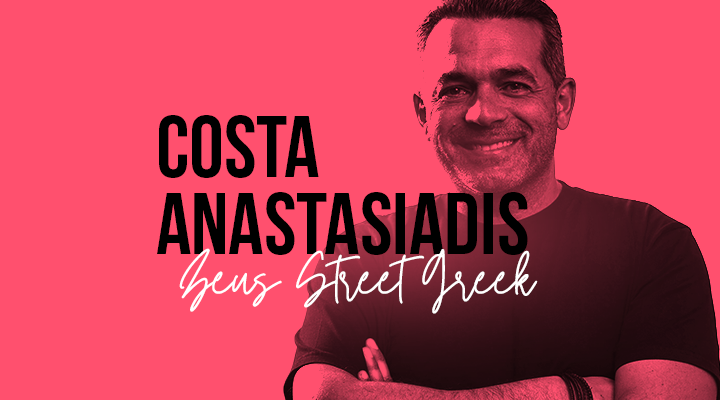
From Crust Gourmet Pizzas to Zeus Street Greek, Costa Anastasiadis has leveraged his heritage and hospitality upbringing to create and scale popular retail food brands.
In this podcast, Costa shares how immersion in the family’s pub and bistro business inspired his first foray into building a brand, and how ‘breaking bread’ with family and friends has been at the heart of his journey in hospitality.
Costa talks about some of the challenges and triumphs of building a $120 million business from scratch, the emotional journey of selling a beloved brand, and the passion for Greek cuisine that fuels his latest venture.
“When you look at Greek [cuisine] and you look at Mediterranean across Australia, although we have a significant Greek diaspora in this country, it’s fair to say that on scale, it’s a fairly new category,” Costa says.
“So when you look at Greek and Mediterranean, there’s really no one that’s scaled what we’ve done to the point that we have.”
Zeus Street Greek now has almost 50 stores, and Costa has taken the brand into supermarkets with branded meal kits.
“When you look at in-home dining, it is a growing category. So whether you’ve got consumers in Townsville or Cairns or Albury, [a meal kit] is a great way to make the foreign feel familiar.
“It really plays into our vision of being Australia’s most loved Greek food brand. So beyond just bricks and mortar stores, for us, having a presence on shelf is very, very important and plays into the greater vision of the business,” Costa says.
In this episode of Spill the Biz, he also shines the spotlight on:
- maintaining good unit economics by managing costs and supply chains, and leveraging technology;
- why overseas expansion isn’t always the answer;
- and why franchising is such an appealing business model.
Show notes
Costa Anastasiadis and Michael Logos launched Crust Gourmet Pizza in Sydney’s inner west suburb of Annandale in 2001. The goal was to provide premium, healthier and gourmet alternatives to the standard pizza fare.
The business began franchising, and grew to more than 100 stores by 2011. In 2012 the pair sold the business to Retail Food Group (RFG) for a total of $41 million.
Zeus Street Greek was founded in Sydney in 2014 and set in motion a brand designed to bridge the gap between casual dining and traditional Greek cuisine.
The chain has a strong presence in New South Wales with 29 stores. It has expanded with six stores in Queensland, seven in Victoria, two in Western Australia and two in ACT.
Zeus Street Greek signed Aussie tennis player Nick Kyrgios this summer and launched Pegasus Pita by Nick Kyrgios, a flame-grilled chicken with a sambal–tamarind aioli, that reflects his Greek/Malaysian heritage.
For six years, from 2018 to 2024, Costa was also a director at gluten-free manufacturing business Choices Foods Group.